
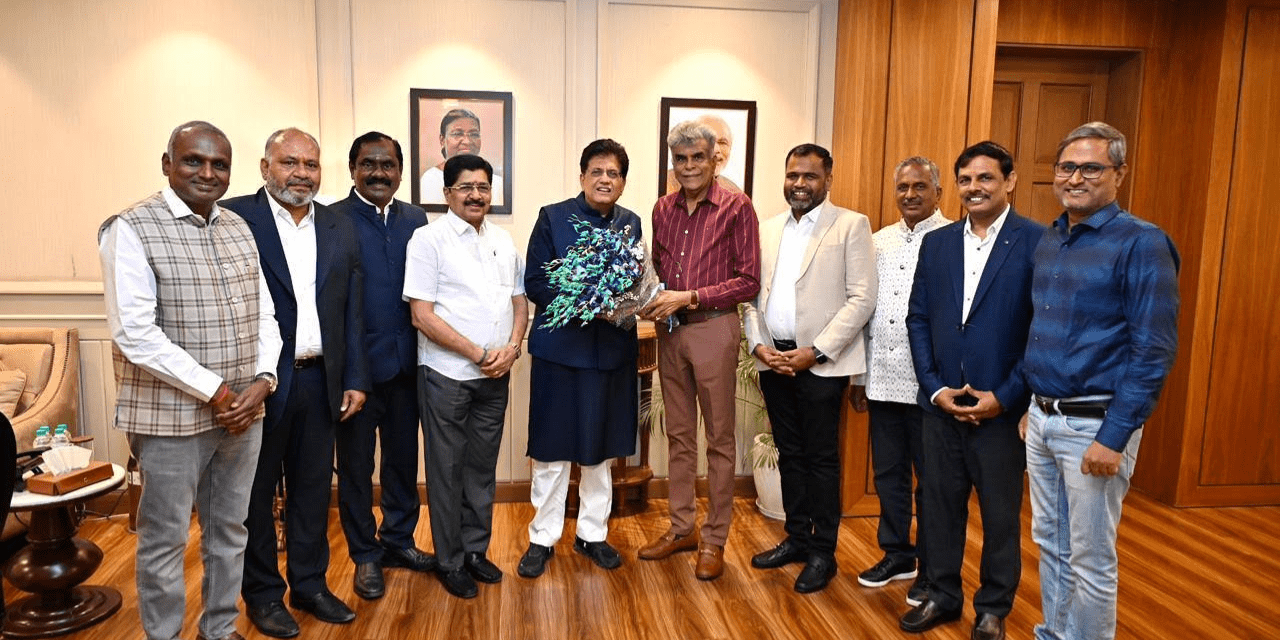
Dr. A. Sakthivel, Chairman of the Apparel Export Promotion Council (AEPC), met with Shri Piyush Goyal, Hon’ble Union Minister of Commerce and Industry, Shri Shivraj Singh Chouhan, Hon’ble Union Minister of Agriculture and Farmers Welfare, and Shri Giriraj Singh, Hon’ble Union Minister of Textiles, along with a delegation representing the apparel and textile industry, to discuss key concerns impacting India’s textile competitiveness.
During the meeting, the delegation submitted representations requesting a reduction in cotton import duty from the current 11 per cent to zero. Industry representatives highlighted that rising cotton prices and increasing input costs are putting pressure on the Indian apparel and textile sector at a time when India is entering multiple Free Trade Agreements (FTAs), opening up significant export opportunities.
The delegation pointed out that competing textile-exporting nations are able to source cotton at internationally competitive prices, while Indian manufacturers continue to face higher raw material costs due to the existing import duty structure. According to the industry representatives, reducing the import duty on cotton is crucial for Indian exporters to compete effectively in global markets and benefit from new FTA opportunities.
The industry also stated that neighbouring countries enjoy better access to competitively priced raw materials, enabling them to offer more attractive pricing to international buyers. Lowering the duty, they said, would improve India’s competitiveness, ensure adequate cotton availability for domestic manufacturers, and support export growth, employment generation, and investments across the textile value chain.
The delegation further highlighted concerns regarding cotton availability for the current year. While the textile industry’s estimated cotton requirement for 2025–26 stands at around 337 lakh bales, projected cotton arrivals are estimated at only 292.15 lakh bales, creating a supply-demand gap of nearly 45 lakh bales. Industry representatives warned that this shortfall could increase pressure on spinning mills and downstream textile segments due to higher input costs and limited access to quality raw materials.
The delegation accompanying the AEPC Chairman included:
- Shri K M Subramaniam, President, TEA
- Shri Shanmugasundaram P, President, SIHMA
- Shri Dhamodharan R, Secretary, SIHMA
- Shri Mohanasundaram K, Trustee, TTPK
- Shri Sudhakar K, Joint Secretary, DAT
- Shri Krishnan P, President, TEKMA
- Shri Srikanth T R, President, TEKPA
- Shri Vivekanand N, President, SIIMK