Automation, efficiency gains, and rising adoption drive growth in textile printing equipment market
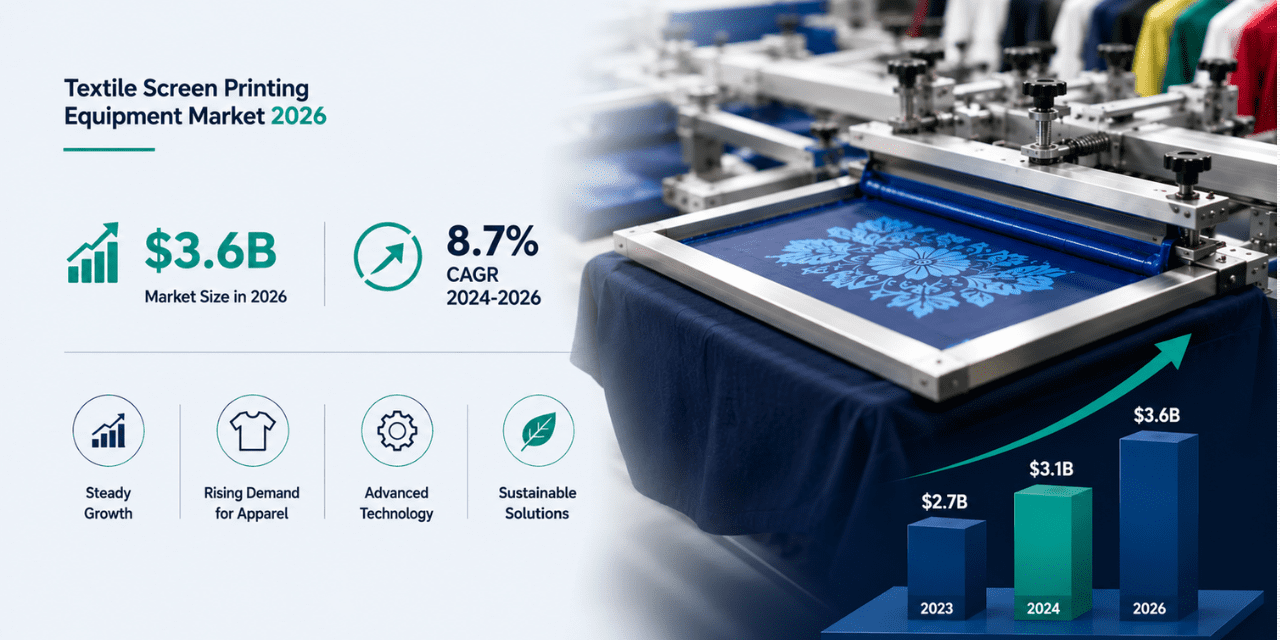
The global textile screen printing equipment market reached $3.6 billion in 2026, expanding from $2.8 billion in 2023, according to industry research from Dataintelo.
The report stated that the market recorded a compound annual growth rate (CAGR) of 8.7% between 2023 and 2026, supported by increased adoption of automated printing systems across textile manufacturing operations.
According to the data, automated textile screen printing machines are capable of producing between 300 and 500 prints per hour, compared to 40 to 60 prints per hour using manual systems. Semi-automatic machines reportedly achieve output levels of 120 to 180 prints per hour.
The shift toward automation has resulted in productivity improvements of 200% to 300%, while labor costs have declined by 25% to 40% in some operations.
Market Growth Between 2023 and 2026
The market showed steady year-on-year expansion during the period:
- 2023: $2.8 billion
- 2024: $3.05 billion
- 2025: $3.32 billion
- 2026: $3.6 billion
The industry added approximately $800 million in market value during the three-year period.
Operational Efficiency Improvements
The report highlighted several operational efficiency gains linked to newer equipment technologies.
Setup times reportedly declined from 45–60 minutes in 2019 to 25–35 minutes in 2025, representing a reduction of around 35%. This reportedly saves more than 900 operational hours annually for businesses managing multiple jobs.
Ink wastage also declined from 12–15% to 8–10%, while energy consumption improved from 12–15 kWh/hour in older systems to 9–11 kWh/hour in newer machines.
Equipment Costs and Return on Investment
Manual textile screen printing machines are priced between $5,000 and $10,000, while semi-automatic systems range from $15,000 to $30,000. Fully automated machines range between $40,000 and $120,000.
The report stated that businesses typically recover investments within 18–30 months due to lower labor costs and increased production capacity.
According to the study, labor requirements can decline from three to five operators to one or two operators after automation, reducing annual labor expenses by an estimated $12,500–$20,000.
Case Study Highlights Production Gains
A case study included in the report described a mid-sized apparel manufacturer that invested $60,000 in upgraded equipment during 2024.
Production increased from 5,000 prints per day to 14,000 prints per day by 2025, representing a 180% increase. Labor requirements declined by 60%, and annual profit reportedly increased by $85,000. The company achieved return on investment in 22 months.
Future Outlook Through 2030
The textile screen printing equipment market is projected to reach $5.2 billion by 2030, with a forecast CAGR of 9.5% from 2026 onward.
The report also projected that automation adoption could increase from 48% in 2023 to 65% by 2030, while AI-assisted printing technologies are expected to reach 30% adoption by 2028.
According to the findings, continued investment in advanced printing technologies is expected to support productivity, operational efficiency, and cost optimization across textile manufacturing.