
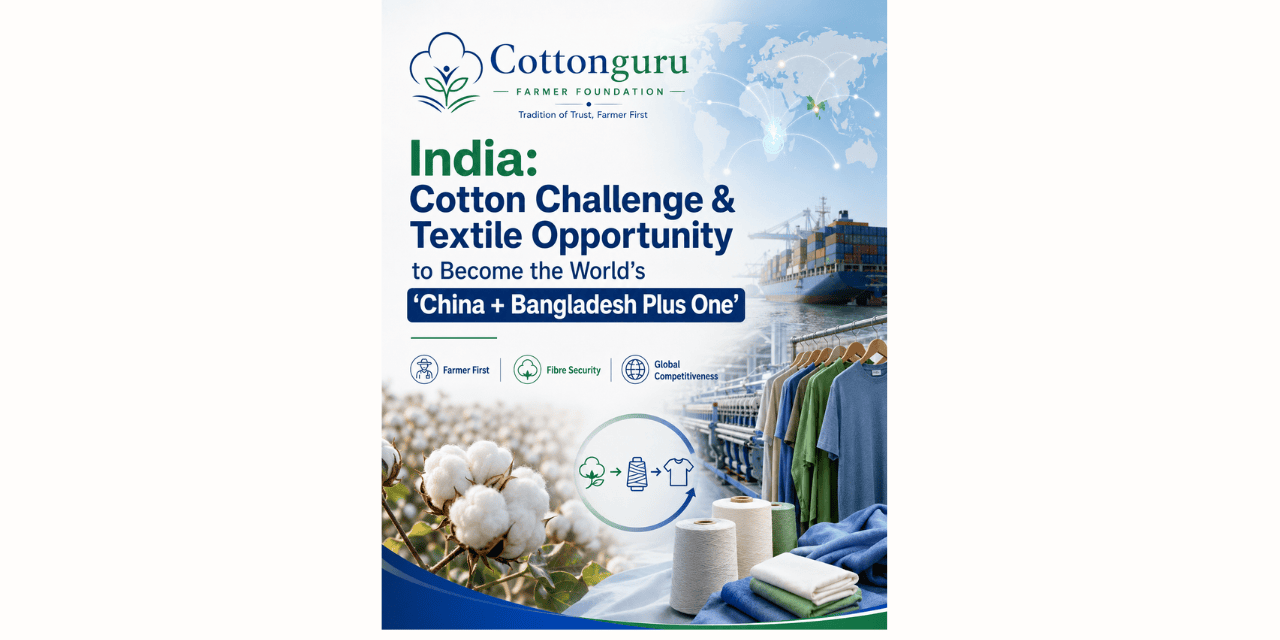
Stable cotton acreage offers some comfort, but productivity, technology, raw-material competitiveness and manufacturing scale will determine whether India can capture the next global textile sourcing wave.
India’s cotton and textile industry is entering a strategically important phase as global sourcing patterns continue to evolve. While the latest cotton sowing data offers stability on the acreage front, persistent concerns around productivity, pest management, technology adoption and raw-material competitiveness remain critical to India’s long-term textile ambitions.
As of 21 August 2026, all-India cotton acreage stood at 108.46 lakh hectares, almost unchanged from the corresponding period last year. However, the national figure masks significant regional changes, with cotton cultivation shifting geographically across the country.
Cotton acreage in North India declined 18.14%, with Punjab, Haryana and Rajasthan recording sharp reductions. In contrast, Gujarat reported a 3.24% increase, Telangana rose 7.26%, Andhra Pradesh increased 4.62%, while the South Zone recorded overall growth of 4.84%. Central India also remained marginally positive.
The shift highlights an important reality: India’s cotton story is no longer simply about the amount of land under cultivation. The final output will increasingly depend on yield, rainfall distribution, pest pressure, crop health and farm-level technology adoption.
Productivity, Not Acreage, Is the Bigger Challenge
India remains one of the world’s major cotton producers, but its productivity continues to trail several leading cotton-producing countries, including China, Brazil and Australia.
One of the most persistent challenges is the growing threat from pink bollworm, alongside other pest and crop-management issues. Farmers also continue to face gaps in access to improved genetics, precision agriculture, mechanisation, modern pest-management solutions and timely agronomic support.
This raises a critical question for the industry: Can India continue to depend on conventional cotton-growing practices when pest pressures and production challenges are evolving?
Maintaining acreage alone will not secure India’s cotton future. The priority must be to produce higher-quality fibre and greater output from every hectare, while reducing contamination and improving consistency.
Global Textile Opportunity Is Expanding
While cotton faces structural challenges, the outlook for India’s textile and apparel industry presents a significant opportunity.
Global brands and buyers are increasingly diversifying their supply chains beyond China. Geopolitical uncertainties, supply-chain resilience strategies and evolving trade agreements are encouraging companies to develop additional sourcing bases.
India is well positioned to benefit from this shift, provided it can convert its manufacturing capabilities into competitive, reliable and scalable supply.
India’s textile and apparel exports reached ₹3.25 lakh crore in 2025–26, with growth recorded across more than 100 export destinations. The figure reflects the scale of India’s existing global presence and provides a strong foundation for further expansion.
However, the next stage of growth will depend less on potential and more on execution.
Moving Beyond “China +1”
For India, the opportunity could be larger than the traditional China+1 strategy.
Bangladesh has established a powerful position in mass-market apparel through large-scale garment manufacturing, competitive conversion costs and specialised export-oriented production systems. China, meanwhile, continues to benefit from enormous manufacturing depth, supply-chain integration, speed and scale.
India has an opportunity to position itself alongside both.
Its biggest strategic advantage is the breadth of its farm-to-fashion ecosystem. India grows cotton, produces fibre and yarn, manufactures woven and knitted fabrics, processes textiles, produces garments and exports finished products.
Few competing sourcing destinations can match this combination of raw-material availability, manufacturing capability and domestic market depth.
But the existence of an integrated ecosystem does not automatically make India the preferred sourcing destination.
International buyers increasingly demand competitive pricing, consistent quality, reliable delivery, compliance, sustainability, traceability and manufacturing scale. India will need to deliver on all these parameters simultaneously.
The Structural Gaps India Must Address
Several challenges could prevent India from fully capturing the emerging global sourcing opportunity.
These include:
- Low cotton productivity per hectare
- Increasing pink bollworm and pest pressure
- Fibre-quality variation and contamination
- High logistics and energy costs
- Smaller-scale garment manufacturing compared with Bangladesh
- Cotton and other raw-material price volatility
- Uneven adoption of advanced technology and mechanisation
- Gaps in speed, scale and supply-chain integration
These issues are particularly important because the global sourcing window will not remain open indefinitely.
Analysis from the Indian Council for Research on International Economic Relations (ICRIER) has highlighted the need for India to move beyond business-as-usual if it wants to capitalise on the China+1 opportunity and compete more effectively with established textile and apparel exporters.
Cotton Competitiveness Must Become Textile Competitiveness
India’s textile strategy ultimately needs to connect the farm with the global buyer.
The cotton sector requires stronger access to better seeds, improved agronomy, modern pest management, mechanisation, contamination control and organised farmer supply chains. Farmer Producer Organisations (FPOs) can play a greater role in building scale, improving traceability and connecting growers with textile manufacturers.
The relationship between farmers and textile companies also needs to evolve. Rather than engaging primarily at the procurement stage, textile manufacturers and brands can work more closely with farmers and FPOs on productivity, fibre quality, traceability and sustainability.
At the manufacturing end, India needs to accelerate garmenting capacity, improve productivity, strengthen logistics, invest in sustainable technologies and make more effective use of free trade agreements to diversify export markets.
The “China + Bangladesh Plus One” Opportunity
India does not need to choose between being a strong cotton producer and becoming a global textile manufacturing hub.
Its real competitive opportunity lies in connecting the two.
A more productive cotton sector can provide a stronger raw-material foundation. A technologically advanced textile industry can convert that raw material into higher-value products. Scaled-up garmenting, efficient logistics and competitive trade access can then connect Indian manufacturing with global buyers.
If these elements are aligned, India could move beyond the conventional “China+1” narrative and emerge as a preferred “China + Bangladesh Plus One” sourcing destination.
Cottonguru’s Final Message
India does not need to choose between becoming a strong cotton producer and a global textile manufacturing hub. Its real opportunity is to become both.
The next phase of India’s textile growth will therefore depend on what happens at both ends of the value chain — from higher cotton productivity in the field to greater scale, speed, quality and sustainability on the factory floor.
The opportunity is significant. The challenge is execution. For India, the time to build the next-generation cotton-to-fashion ecosystem is now.