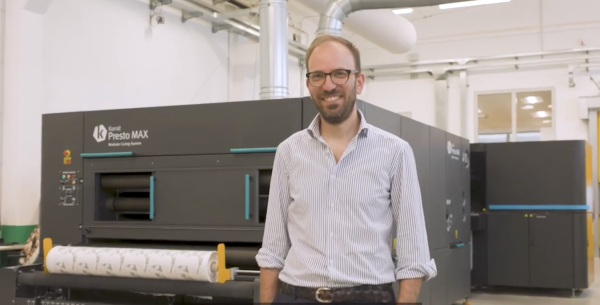
Italian textile dyeing and finishing specialist Tintoria Finissaggio 2000 has integrated the Kornit Presto MAX into its production environment.
The investment will support premium textile production, digital printing and more flexible manufacturing. It will also help the company respond to demand for customised and sustainable textile production.
Kornit Presto MAX Supports Digital Textile Printing
The Kornit Presto MAX is designed for industrial roll-to-roll textile printing. It uses a single-step digital pigment printing process.
The system does not require traditional pre-treatment and post-treatment steps. This can reduce water and energy use. It also helps shorten production time.
Tintoria Finissaggio 2000 is based in Biella, Italy. The company has worked in textile dyeing and finishing since 1972.
Its services include dyeing, finishing, printing and lamination. The family-owned business serves luxury fashion brands, textile manufacturers and fabric converters.
Focus on Flexible Textile Manufacturing
The company identified three key goals for its latest technology investment. These include developing new textile products, reducing water use in printing and supporting shorter production runs.
Dino Masso, Owner and CEO of Tintoria Finissaggio 2000, said the company wanted technology that could combine creativity with more efficient production.
“In Italy, we describe our work as ‘ennobling’ fabrics,” said Masso. “That means transforming a fabric into something better through technology, creativity and know-how. Every investment we make is about creating new opportunities for our customers, and Presto MAX represents the next evolution of that philosophy.”
According to Masso, the Kornit Presto MAX met all three requirements. The system also gives the company a digital printing platform for customised textile production.
New Possibilities for Premium Pigment Printing
Tintoria Finissaggio 2000 also worked with Kornit to develop premium pigment-printed fabrics.
The company focused on colour, softness and print definition. These factors are important for luxury textile applications.
“When we saw the first results, we were genuinely impressed,” Masso said. “The quality, the hand feel and the appearance exceeded our expectations. That was the moment we knew we had made the right investment.”
Kornit states that Presto MAX can produce vivid colours and enhanced hand feel across a range of textile applications. The system also supports white printing on coloured fabrics, neon designs and XDi effects.
Supporting On-Demand Textile Production
Presto MAX is now part of Tintoria Finissaggio 2000’s manufacturing workflow.
The company can use the technology to develop new products and support shorter production runs. It also provides a digital option for brands seeking more flexible production models.
“We don’t see Presto MAX simply as a printing machine,” Masso concluded. “It’s a platform that changes the way we serve the market. As the textile industry moves toward producing only what is needed, technologies like this will be essential for building a faster, more sustainable and more flexible supply chain.”