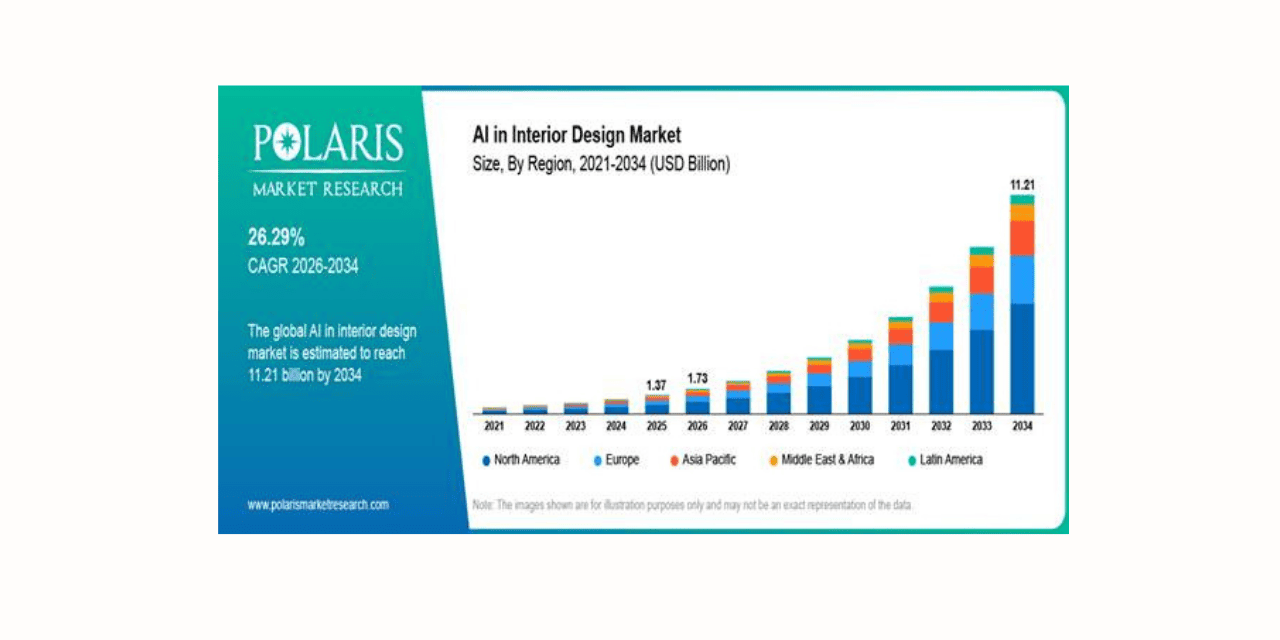
The global AI in Interior Design Market is witnessing rapid expansion as artificial intelligence increasingly becomes an integral part of residential and commercial design workflows. According to a new market analysis released by Polaris Market Research & Consulting, the market was valued at USD 1.37 billion in 2025 and is projected to reach USD 11.21 billion by 2034, registering a CAGR of 26.29% from 2026 to 2034.
North America currently leads the market, while growing adoption of AI-powered design solutions across architecture, interior design, real estate and residential applications is expected to support continued industry growth.
Artificial intelligence is transforming traditional interior design processes by enabling faster planning, automated layouts, furniture placement recommendations, colour scheme suggestions and high-quality 3D visualizations. These capabilities allow professionals and homeowners to develop customized concepts more efficiently while giving clients an opportunity to visualize spaces before construction, renovation or redesign begins.
“Artificial intelligence technology is playing a crucial role in boosting the efficiency of the interior design industry players. Companies are continuously investing in intelligent design platforms that are boosting the efficiency of projects and providing enhanced customer experience through personalized design solutions. Companies that will keep on investing in AI technologies and develop scalable solutions are likely to bolster their competitiveness in the era of digital transformation.” — Apurva Agarwal, Senior Technology Analyst
Generative AI Accelerates Interior Design Workflows
Generative AI is emerging as a major technology influencing interior design processes. Interior designers, architects and real estate companies are increasingly exploring AI tools to automate concept development, room planning, furniture selection and visualization.
AI-generated concepts can reduce the time required to create initial design proposals while enabling professionals to explore multiple layouts and styles. Faster iterations can also improve communication with clients and contribute to enhanced customer satisfaction.
Cloud-Based Platforms Expand Market Adoption
The growing availability of cloud-based design platforms is another factor supporting the expansion of the AI in Interior Design Market. SaaS-based solutions allow businesses and individual users to access design capabilities without requiring extensive IT infrastructure.
Cloud platforms also enable teams to collaborate remotely, manage multiple projects and share design updates in real time. This flexibility is expected to encourage wider adoption among design firms, architects, real estate companies and other businesses.
3D, AR and VR Enhance Customer Experience
AI is increasingly being combined with 3D rendering, augmented reality (AR) and virtual reality (VR) to create more immersive interior design experiences.
Customers can preview furniture, lighting, colours, décor and spatial arrangements before making purchasing or renovation decisions. Such visualization capabilities can improve buying confidence and potentially reduce design revisions during later stages of a project.
Continued development of immersive visualization technologies is expected to create further opportunities for AI-powered interior design platforms.
Smart Homes Create New Opportunities for AI
The expansion of smart-home technologies is also creating opportunities for AI-enabled interior planning. Consumers are increasingly seeking personalized residential environments that integrate technology, functionality and aesthetics.
AI-powered platforms can support the planning of spaces around individual preferences, furniture requirements and technology integration. This convergence of smart-home solutions and intelligent design is expected to encourage further investment in AI-based residential design technologies.
Investment Outlook for AI in Interior Design
The market is attracting investment across several technology themes, including generative AI, cloud-based design platforms, smart-home integration and broader digital transformation.
For software developers and AI solution providers, the increasing demand for automated visualization and room planning is creating opportunities to develop scalable platforms. Meanwhile, recurring-revenue models associated with cloud-based solutions could support wider enterprise adoption.
AI adoption across architecture, construction and real estate is also expected to encourage software innovation and strategic commercial partnerships.
With AI increasingly moving from an emerging technology to a practical design tool, the interior design industry is expected to undergo significant digital transformation through the forecast period. The combination of personalized design, faster workflows, cloud collaboration and immersive visualization is likely to remain central to the market’s growth through 2034.