
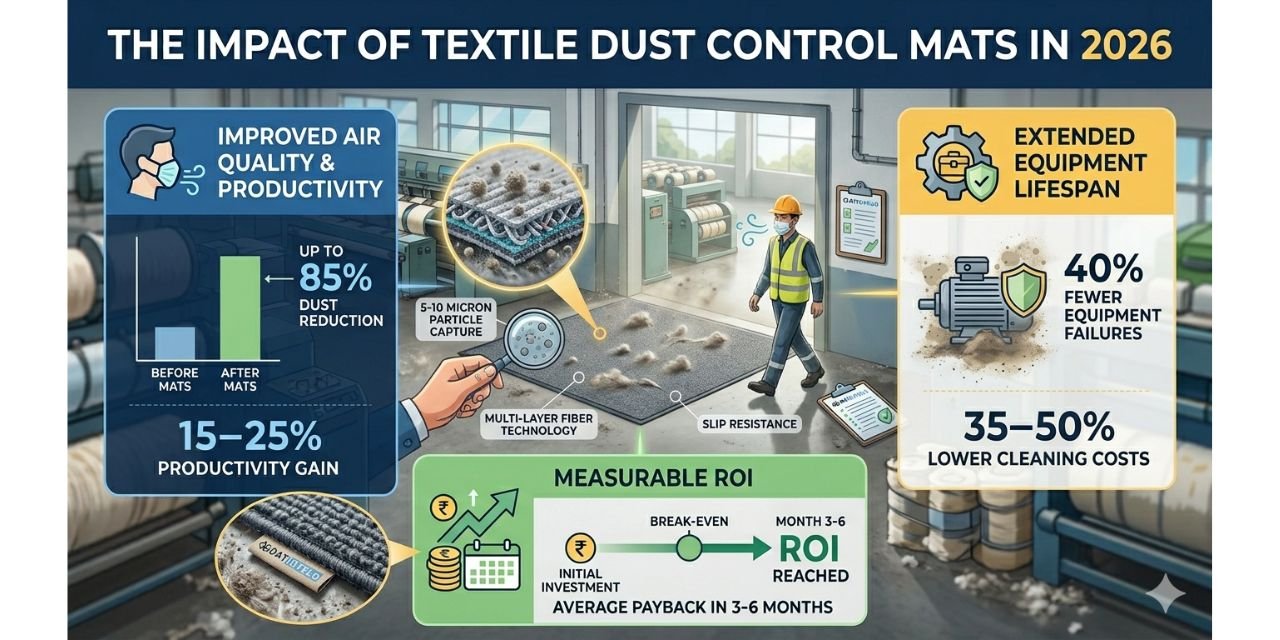
In 2026, industrial hygiene and workplace safety have become essential, measurable priorities across manufacturing sectors. According to Dataintelo, the textile dust control mats market has reached an estimated valuation of $1.9 billion, driven by increasing regulatory compliance, automation, and the need for cleaner production environments.
These engineered mats are now widely adopted across textile mills, garment factories, warehouses, and cleanrooms, where controlling airborne particles directly impacts productivity, equipment lifespan, and operational costs.
Proven Impact on Dust Reduction and Air Quality
Recent studies (2023–2025) highlight that modern textile dust control mats can reduce airborne dust levels by 60–85%, significantly improving indoor air quality by 20–30%. Advanced multi-layer fiber technology enables these mats to capture particles as small as 5–10 microns, far exceeding the capabilities of older systems.
This improvement is critical as global occupational safety standards have tightened by up to 18% in recent years.
Cost Savings and Operational Efficiency
The adoption of dust control mats delivers substantial financial benefits. Facilities report a 35–50% reduction in cleaning costs, as well as a significant decrease in daily maintenance efforts.
Additionally, reduced dust accumulation leads to:
- Up to 40% fewer equipment failures
- 25–30% reduction in filter replacements
- Lower overall maintenance expenses
For mid-sized manufacturing units, this translates into annual savings ranging from several lakhs to over ₹20 lakh for large-scale plants.
Productivity Gains and Workplace Benefits
Cleaner environments have a direct impact on workforce performance. Studies show a 15–25% increase in worker productivity, along with reduced fatigue and fewer sick days due to improved air quality.
In a typical facility, this can result in significantly higher output and operational efficiency on a daily basis.
Rapid ROI and Long-Term Value
Textile dust control mats are increasingly viewed as a high-return investment. With installation costs ranging between ₹3–8 lakh and relatively low maintenance expenses, most facilities achieve:
- Break-even within 3–6 months
- Annual ROI of 150–300%
Modern mats also offer improved durability, with lifespans extending up to 2–4 years and the ability to withstand hundreds of wash cycles without performance loss.
Technology Advancements Driving Performance
Compared to earlier models, 2026 dust control mats offer:
- Enhanced particle capture efficiency
- Better moisture absorption and slip resistance
- Improved static control, reducing dust attraction
Despite a moderate increase in pricing over the years, performance improvements of 30–35% ensure better long-term value for industrial users.
Market Growth and Future Outlook
The global textile dust control mats market is expanding rapidly, growing from $1.2 billion in 2022 to $1.9 billion in 2026, and is projected to reach $3.1 billion by 2028, reflecting a strong 18–22% CAGR.
Key growth drivers include:
- Stricter workplace safety regulations
- Increased use of dust-sensitive automated machinery
- Rising ESG and sustainability compliance requirements
Conclusion
Textile dust control mats have evolved into a critical component of modern industrial infrastructure. By delivering measurable improvements in dust reduction, cost savings, and productivity, they are no longer optional but essential for competitive and compliant manufacturing operations.
With strong market growth, rapid ROI, and continuous technological advancements, their adoption is set to accelerate across the global textile industry.