ASSOCHAM to Host Farm to Foreign Conclave in Mumbai
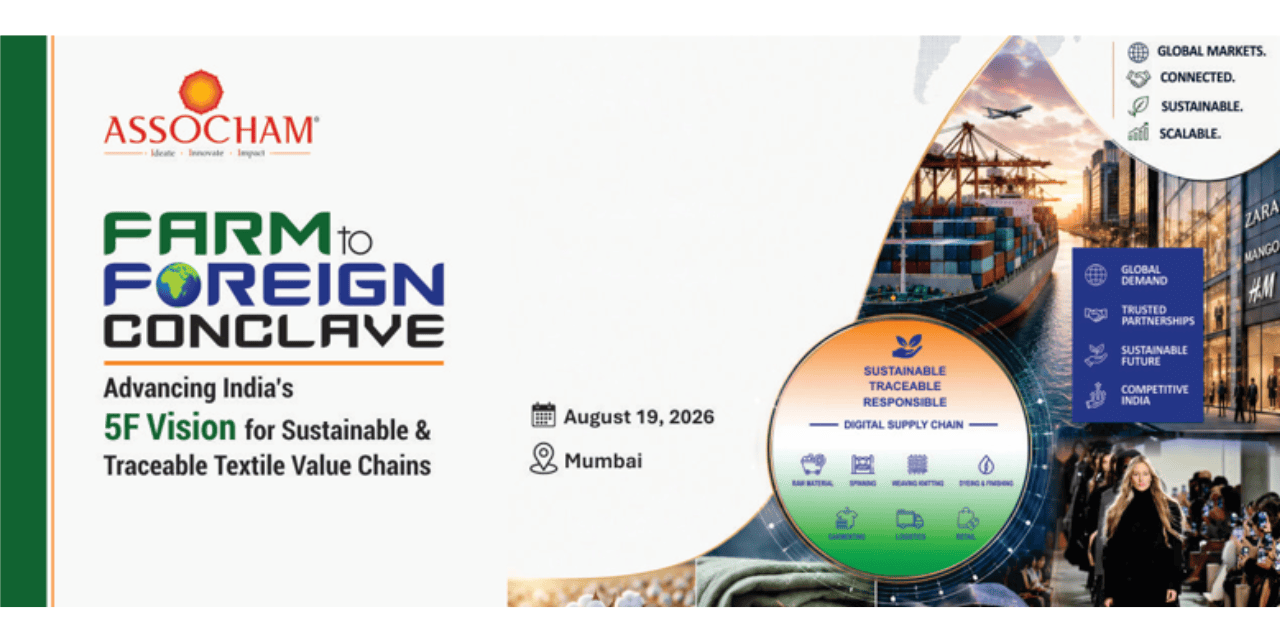
ASSOCHAM Maharashtra State Council will host the Farm to Foreign Conclave on August 19, 2026, in Mumbai. The event will focus on India’s 5F Vision and the growth of sustainable, traceable textile value chains.
The Farm to Foreign Conclave 2026 will bring together leaders from across the textile industry. Participants will include government officials, manufacturers, exporters, global brands and retailers.
Farmers’ organisations, sustainability experts, technology providers and certification agencies will also attend. Financial institutions and other industry leaders will join the discussions.
The event aims to build a more connected and transparent textile industry. It will also explore ways to make textile production more environmentally responsible.
Farm to Foreign Conclave to Advance India’s 5F Vision
The conclave supports the Government of India’s 5F Framework: Farm to Fibre to Factory to Fashion to Foreign. This vision aims to connect every stage of the textile value chain. It also promotes technology use and stronger exports.
Several government programmes support this goal. These include the Mission for Cotton Productivity, PM MITRA Parks and the National Technical Textiles Mission.
These initiatives aim to strengthen India’s manufacturing sector. They also encourage sustainable production and new technologies.
Global Rules and Sustainable Textile Production
Global markets are placing greater focus on sustainability and supply-chain transparency. New rules are also changing how textile businesses operate.
These include the EU Green Deal, Digital Product Passport (DPP) and Extended Producer Responsibility (EPR). Other important areas include the Carbon Border Adjustment Mechanism (CBAM) and ESG reporting.
The conclave will help Indian businesses understand these changes. It will discuss global compliance rules and responsible sourcing needs.
Four Sessions to Cover the Textile Value Chain
The programme will feature four sessions. Each session will focus on a different stage of the textile value chain.
1. From Soil to Sustainable Fibre
This session will focus on better farming practices. Topics will include regenerative agriculture, climate-resilient farming and water conservation.
Experts will also discuss biodiversity, soil health and fibre traceability. The session will explore opportunities for growing cotton, hemp and bamboo.
It will also highlight the role of farmers, FPOs, certification bodies and industry partners.
2. Fibre to Fabric: Scaling Responsible Manufacturing
This session will examine cleaner ways to produce textiles. Topics will include sustainable processing, green chemistry and energy efficiency.
The discussion will also cover water conservation and chemical management. Experts will explore digital tools that improve supply-chain traceability and manufacturing efficiency.
3. Design to Lifecycle: Circular Fashion and Future Retail Trends
This panel will examine sustainable product design and circular fashion. It will cover recycling, efficient material use and waste reduction.
Product durability will also be an important topic. The panel will discuss how EPR rules and product lifecycle transparency can support responsible fashion and retail.
4. Farm to Foreign: Traceability and Export Readiness
The final session will focus on India’s textile exports. It will examine blockchain-based traceability and digital supply chains.
Experts will also discuss sustainability certifications and ESG practices. The session will explore ways to help MSMEs meet international market requirements.
More Than 20 Industry Experts to Participate
The conclave will feature more than 20 industry experts and thought leaders. It will offer opportunities for knowledge sharing, business discussions and networking.
The event aims to connect agriculture, manufacturing, fashion and global trade. Through these discussions, it seeks to support sustainable growth across India’s textile value chain.
The Farm to Foreign Conclave also aims to strengthen India’s position in global markets. Its focus will remain on transparent production, sustainability and export growth.