
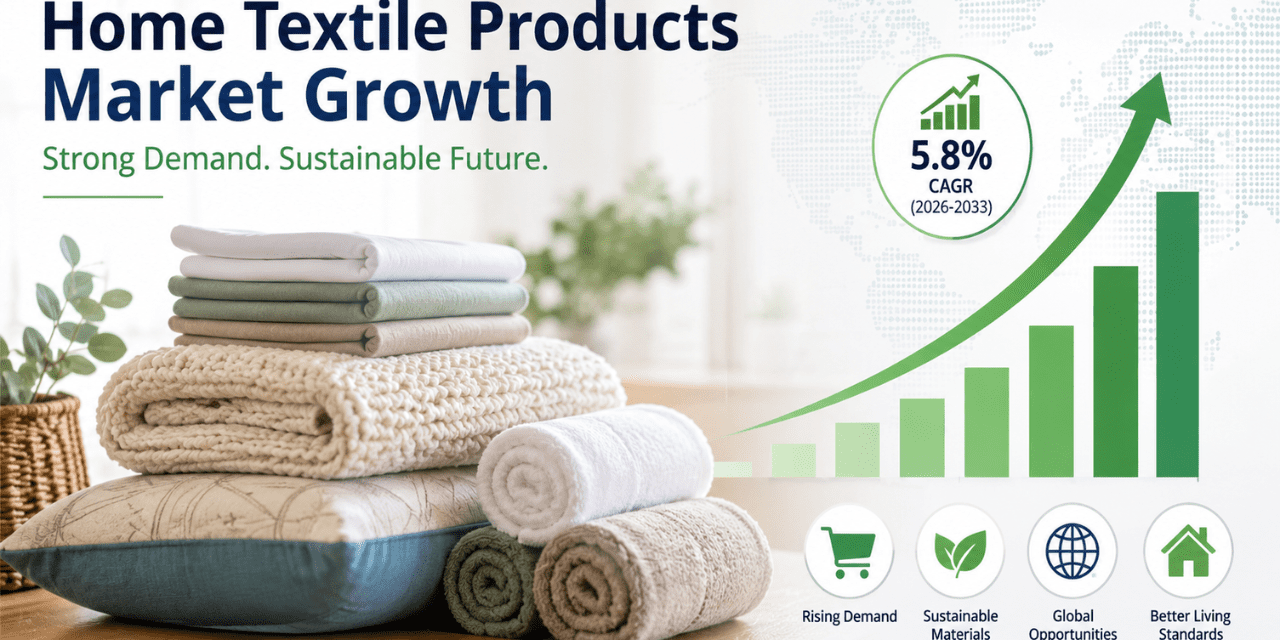
Rising demand for sustainable, smart and premium products continues to shape the home textile industry
The global home textile products market is continuing to expand as consumer demand for comfort, sustainability and premium home interiors increases across regions. According to market observations by Dataintelo, the industry crossed USD 135 billion in 2025 and is projected to grow at a CAGR of 5.8% between 2026 and 2033.
The sector includes products such as bed linen, curtains, towels, upholstery fabrics, carpets, cushions, blankets and kitchen textiles. Industry data indicates that online sales of home décor and textile products increased by nearly 38% globally between 2021 and 2024, while Asia Pacific accounted for approximately 46% of global textile manufacturing output in 2025.
Key Market Metrics
- Global market value in 2025 reached USD 135 billion
- Expected CAGR for 2026–2033 stands at 5.8%
- Asia Pacific production share reached 46%
- Online sales growth from 2021–2024 increased by 38%
- Cotton textile demand rose by 12% between 2024–2025
- Sustainable textile adoption increased by 29%
- Smart textile segment projected CAGR stands at 8.4%
- Luxury bedding market growing at 7.1% annually
- U.S. home textile imports reached USD 29 billion in 2025
- Average annual household textile spending increased to USD 780
- Recycled fiber utilization rose by 31%
- Hospitality textile demand increased by 18%
- Antimicrobial textile demand rose by 22%
- Digital textile printing adoption increased by 27%
- Europe accounted for 34% of sustainable textile market share
Market Growth Drivers
The report highlighted that rising urbanisation, growing disposable incomes and expanding e-commerce platforms are contributing significantly to industry growth.
Between 2022 and 2025, annual household spending on home furnishing textiles increased from USD 640 to USD 780 per household globally, representing a 21.8% increase. Other measurable growth indicators include:
- Urban housing projects increased by 14% globally in 2025
- Premium bedding product sales rose by 19% year-over-year
- Smart textile integration expanded by 26% since 2023
- Eco-friendly material demand increased by 29% globally
- Hospitality textile procurement rose by 18% after tourism recovery
The expansion of short-term rental platforms and luxury hospitality chains has also contributed to higher demand for towels, bed sheets and upholstery products.
Sustainability and Smart Textile Demand
The market is also seeing increased demand for sustainable and technology-driven textile products. According to consumer surveys cited in the report, 63% of buyers in 2025 preferred sustainable or recycled textile products, while recycled polyester usage in home furnishings increased by 31% between 2022 and 2025.
Smart home textile applications, including temperature-regulating bedding, smart curtains and antimicrobial fabrics, are expected to remain a major growth area. The smart textile segment is forecast to grow at a CAGR of 8.4% through 2033.
Digital textile printing adoption has also increased by 27% since 2021, helping manufacturers reduce production waste by nearly 18% while enabling customised designs and shorter production cycles.
Regional Market Trends
Asia Pacific
Asia Pacific remained the largest manufacturing hub in 2025, contributing 46% of total production capacity. China and India together exported more than USD 52 billion worth of home textile products during the year.
North America
The United States imported approximately USD 29 billion in home textile products in 2025, with bedding accounting for nearly 39% of total imports.
Europe
Europe accounted for 34% of the global eco-friendly textile market share, while organic cotton bedding demand increased by 24% in 2025.
Middle East & Africa
Luxury hospitality expansion in the Middle East increased premium textile demand by 15% year-over-year, particularly in the UAE and Saudi Arabia.
Industry Challenges
Despite continued growth, manufacturers are facing several operational challenges:
- Cotton prices fluctuated by 16% in 2025
- Manufacturing energy costs increased by 11%
- Supply chain delivery timelines extended by 9 days
- Labor shortages reduced production efficiency by 7%
The report noted that companies investing in automation, sustainable sourcing and digital retail channels are maintaining stronger profit margins compared to competitors.
Outlook Through 2033
Industry projections indicate that the global home textile products market could exceed USD 210 billion by 2033 if current growth trends continue. Smart textiles, recycled fibers and premium bedding categories are expected to account for more than 48% of incremental revenue growth during the forecast period.
E-commerce is also projected to contribute more than 50% of total industry sales by 2030, further reshaping retail distribution and consumer engagement strategies.