
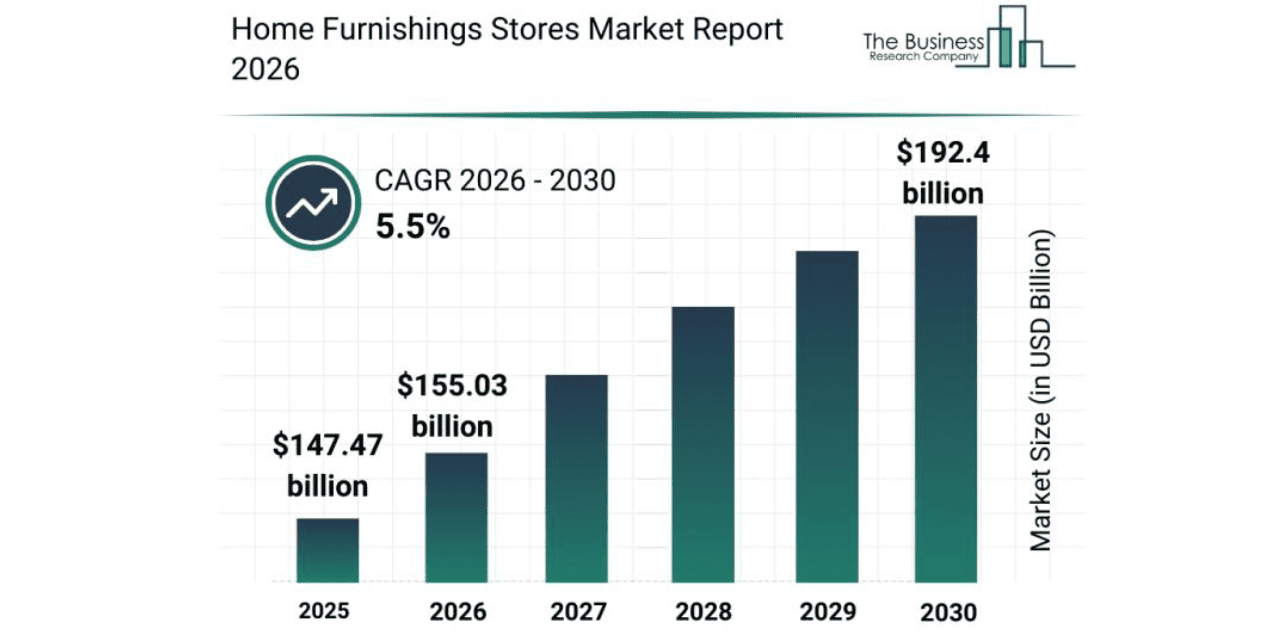
Home Furnishings Stores Market to Reach $192.4 Billion by 2030 Amid E-commerce and Sustainability Trends
The global home furnishings stores market is projected to reach $192.4 billion by 2030, expanding at a compound annual growth rate (CAGR) of 5.5%, driven by rising demand for smart furniture, sustainable products, premium home textiles, and technology-enabled retail experiences.
Changing consumer lifestyles, rapid digitalisation, and growing interest in personalised home interiors are reshaping the market, while retailers continue investing in omnichannel strategies and innovative product offerings.
Market Growth Driven by Smart and Sustainable Living
Several factors are supporting the market’s steady expansion, including:
- Rising adoption of smart furniture solutions
- Growth of e-commerce furniture sales
- Increasing demand for sustainable home furnishings
- Greater use of technology in retail operations
- Growing popularity of personalised interior design services
Industry trends indicate increasing consumer preference for modular and multifunctional furniture, premium home textiles, customised home décor, and immersive showroom experiences that combine digital and physical retail.
Major Industry Participants
The global market features several established furniture and home furnishing retailers, including Ashley Furniture Industries, Inter IKEA Group, Wayfair, Home Depot, Williams-Sonoma, Rooms To Go, Crate & Barrel, Ethan Allen, La-Z-Boy, Pottery Barn, RH, Havertys, Bassett Furniture, Raymour & Flanigan, American Furniture Warehouse, Nebraska Furniture Mart, Bob’s Discount Furniture, Jordan’s Furniture, Value City Furniture, Mathis Brothers Furniture, Living Spaces, Badcock Home Furniture & More, Leon’s Furniture, Dufresne Furniture & Appliances, Bernie & Phyl’s Furniture, Kane’s Furniture, El Dorado Furniture, Arhaus, and Ballard Designs.
Ashley Home Strengthens Bedding Portfolio
In March 2024, Ashley Home Inc. acquired Resident Home Inc., a digitally native mattress and bedding company.
The acquisition is intended to strengthen Ashley’s direct-to-consumer and wholesale operations while expanding its mattress and bedding portfolio through Resident Home’s established e-commerce capabilities.
Technology Innovation Gains Momentum
Technology continues to influence product development across the home furnishings sector.
In March 2023, Italian lighting company LUCE5 introduced Tech Thickness (TT), an aluminium-based composite technology that integrates lighting into furniture while reducing weight and improving structural strength.
The technology also offers environmental benefits through reduced carbon emissions and 95% recyclability, supporting applications across retail, luxury interiors, hospitality, marine, and design-focused furniture.
Sustainability and Customisation Shape Future Demand
Manufacturers are increasingly focusing on environmentally responsible materials, recyclable products, and personalised shopping experiences to meet evolving consumer expectations.
These initiatives are helping retailers differentiate their product offerings while supporting long-term sustainability goals.
Market Segmentation
The Home Furnishings Stores Market is segmented as follows:
By Product
- Home Furniture
- Home Textiles
- Wall Décor
By Price Range
- Mass Market
- Premium Market
By Sales Channel
- E-commerce
- In-store Retail
Within these categories, home furniture includes living room, bedroom, dining, office, and storage products, while home textiles cover bed linens, curtains, rugs, towels, cushions, and throws. Wall décor includes artwork, mirrors, clocks, shelves, and decorative accessories.
Enhanced Market Intelligence
The latest market reports now include expanded strategic analysis featuring:
- Market attractiveness analysis
- Total Addressable Market (TAM) assessment
- Company benchmarking matrices
- Excel forecasting dashboards
- Market hotspot infographics
- Technology trend analysis
- Updated charts and graphical insights
The continued expansion of online retail, sustainability initiatives, product innovation, and consumer demand for personalised interiors is expected to support steady growth across the global home furnishings market through 2030.