
The global living room textiles market has recorded steady expansion over the past decade, supported by increasing consumer expenditure on home décor, rapid growth of e-commerce, and rising urban housing development worldwide. Demand accelerated significantly after 2021 as households invested more in interior upgrades and home comfort solutions.
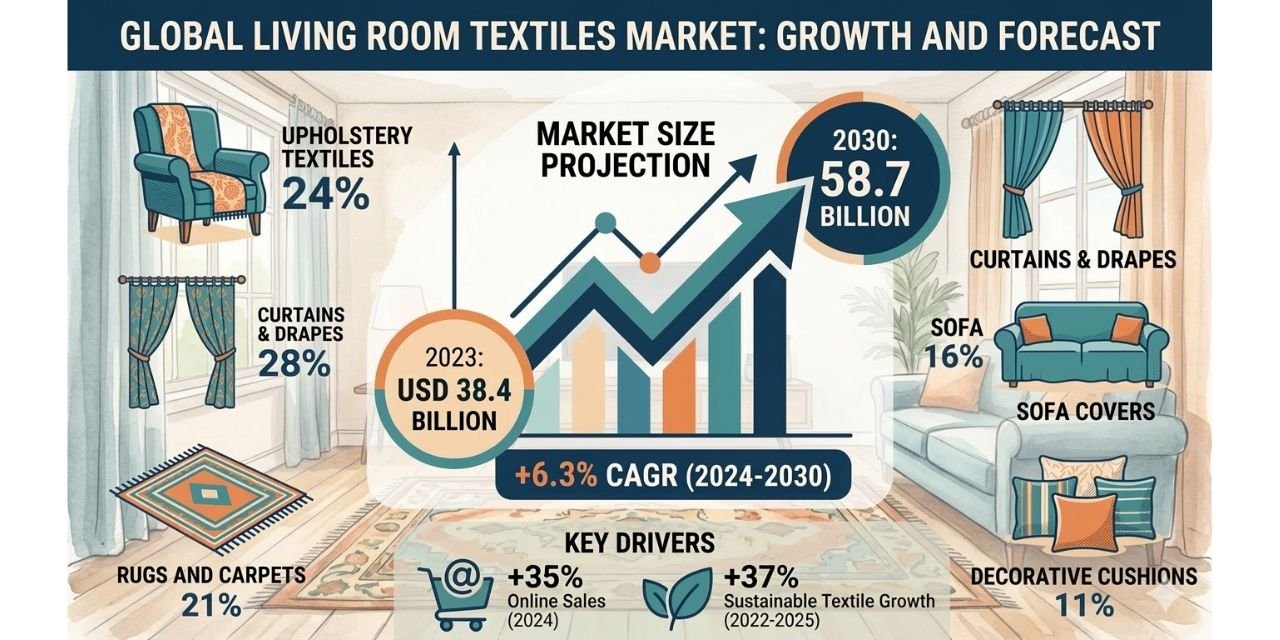
Industry analysis published by Dataintelo in 2023 estimated the global market for living room textiles at USD 38.4 billion. The sector is projected to reach approximately USD 58.7 billion by 2030, representing a compound annual growth rate (CAGR) of 6.3% between 2024 and 2030.
Products including curtains, upholstery fabrics, sofa covers, rugs, and decorative cushions represent a substantial share of consumer spending on household textiles. The sector’s expansion reflects evolving consumer lifestyles and the increasing importance of interior design in residential spaces.
Key Market Metrics
Recent data highlights the growing economic importance of the living room textiles segment:
Global market size (2023): USD 38.4 billion
Projected market size (2030): USD 58.7 billion
CAGR (2024–2030): 6.3%
Curtains and drapes share: 28% of the market
Upholstery textiles: 24%
Rugs and carpets: 21%
Decorative cushions: 11%
Online sales share (2024): 35% of purchases
Growth in e-commerce textile sales (2021–2024): 48%
Increase in household décor budgets (2020–2024): 32%
Asia-Pacific market share: 42%
Growth in sustainable textile adoption (2022–2025): 37%
These figures underline the sector’s increasing role within the broader global home décor market.
Key Drivers Supporting Market Expansion
Rising Consumer Spending on Home Décor
Consumer investment in home décor products has risen steadily in recent years. Global spending on home décor reached USD 747 billion in 2024, compared with USD 663 billion in 2021.
Living room décor accounts for around 31% of total household décor budgets, making it one of the most important categories in interior spending. Average household expenditure on living room furnishings and textiles increased from USD 470 in 2020 to USD 620 in 2024, reflecting a 32% rise in spending. Hybrid work arrangements and home renovation trends have contributed to this growth.
Expansion of Online Textile Retail
Digital commerce has significantly changed the way consumers purchase textile products. Between 2021 and 2024, the share of online sales in the living room textiles market increased from 22% to 35%.
During the same period, global online textile revenue grew from USD 7.8 billion to USD 11.5 billion. Mobile commerce has also become a key driver, representing 61% of online décor purchases. Online platforms allow consumers to compare designs, prices, and product features more easily, encouraging faster purchasing decisions.
Urban Housing Development
Urbanization continues to influence the demand for living room textile products. The global urban population increased from 4.46 billion in 2021 to 4.61 billion in 2023, and is expected to reach 4.74 billion by 2025.
The number of new urban homes built annually is also increasing, rising from 43 million units in 2021 to an estimated 51 million by 2025. Each new household typically requires multiple textile products such as curtains, rugs, sofa covers, and decorative cushions, creating ongoing demand across the sector.
Growth of Sustainable Textile Materials
Sustainability has become a major factor shaping textile purchasing decisions. Between 2022 and 2025, demand for organic cotton upholstery fabrics increased by 29%, while recycled polyester textiles expanded by 41%. Textile products made from bamboo fibers have also recorded an annual growth rate of around 18%.
By 2025, environmentally friendly materials are expected to represent 26% of the living room textiles market, compared with 16% in 2021. Consumers are also willing to pay a price premium of 12–18% for eco-friendly textile products.
Product Segmentation
Different textile categories contribute varying shares to overall revenue.
Curtains and drapes: 28% market share, 5.9% CAGR
Upholstery fabrics: 24% market share, 6.5% CAGR
Rugs and carpets: 21% market share, 6.1% CAGR
Sofa covers: 16% market share, 6.8% CAGR
Cushions and throws: 11% market share, 7.2% CAGR
Decorative cushions and throws are currently the fastest-growing category due to their affordability and shorter replacement cycles. Consumers typically replace cushions every two to three years, curtains every five to seven years, and rugs every six to eight years, supporting recurring demand.
Regional Market Trends
Asia-Pacific
The Asia-Pacific region leads the global market with a 42% share in 2024. Growth is supported by urbanization, rising middle-class populations, and strong textile manufacturing capacity.
China and India together account for approximately 27% of global demand, and the region is projected to grow at a 7.1% CAGR through 2030.
North America
North America represents around 24% of the global market. Households in the region spend an average of USD 1,200 annually on décor, and online channels account for 48% of textile purchases. Demand for premium materials such as velvet and performance fabrics contributes to market value growth.
Europe
Europe holds roughly 22% of global living room textile demand. The region shows strong adoption of sustainable materials and compliance with environmental regulations. Eco-certified textiles recorded 34% growth between 2022 and 2025.
Market Outlook
Market forecasts indicate continued expansion through the end of the decade. The sector is expected to grow from USD 40.7 billion in 2024 to USD 58.7 billion by 2030.
Key factors expected to drive growth include:
Integration of smart home décor technologies
Increasing demand for customizable textile designs
Ongoing innovation in sustainable materials
Expansion of online furniture and home décor marketplaces
Conclusion
The global living room textiles sector continues to expand steadily, with strong consumer demand for home décor products supporting long-term growth. From a market value of USD 38.4 billion in 2023, the industry is projected to add more than USD 20 billion in new value by 2030.
Rising décor expenditure, the rapid expansion of e-commerce, increasing urban housing, and growing demand for sustainable materials are expected to remain the primary drivers shaping the future of the living room textiles market.