
Ministry of Textiles Conducts Gram Swaraj Workshop to Strengthen Rural Artisan Ecosystem
Two-day programme at NIFT Gandhinagar focuses on entrepreneurship, innovation, market linkages and sustainable livelihoods for artisans and weavers
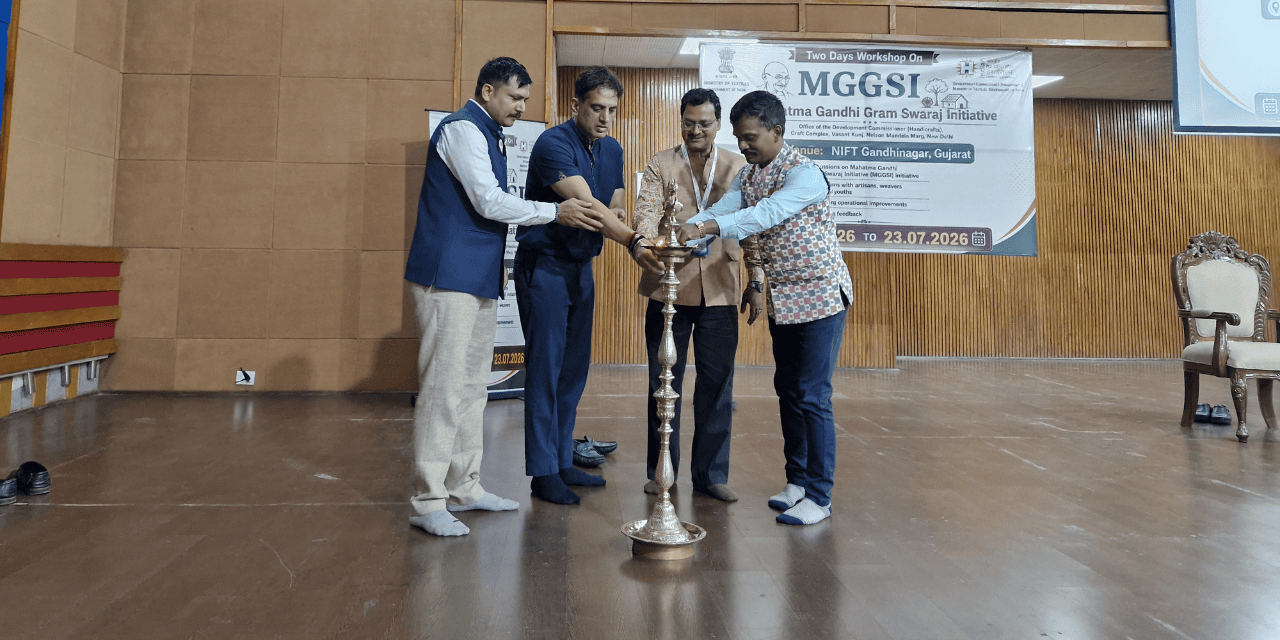
The Office of the Development Commissioner (Handicrafts), Ministry of Textiles, Government of India, organized a two-day workshop under the Mahatma Gandhi Gram Swaraj Initiative at the National Institute of Fashion Technology (NIFT), Gandhinagar, from 22–23 July 2026. The programme brought together nearly 100 handicraft artisans, handloom weavers and Khadi weavers from Goa, Maharashtra, Gujarat, Chhattisgarh and Madhya Pradesh to discuss rural entrepreneurship, skill development and the effective implementation of government initiatives.
The workshop was designed as an interactive platform to facilitate direct engagement between policymakers and artisans, identify operational challenges, exchange best practices and develop strategies to strengthen the Mahatma Gandhi Gram Swaraj Initiative.
Industry Experts Highlight Role of Textiles in Viksit Bharat @2047
The workshop was inaugurated by Prof. (Dr.) Sameer Sood, Director, NIFT Gandhinagar, in the presence of Sh. Deeptansu Haldar, Regional Director (Western Region), Office of the Development Commissioner (Handicrafts); Sh. Bidhan Das, Deputy Director, Indian Institute of Packaging; and Dr. Rajendra Prasad Sharma, Professor & Head, Indian Institute of Foreign Trade (IIFT), GIFT City Campus.
Addressing participants, Prof. Sood emphasized the significant contribution of India’s textile, handloom and handicrafts sectors to the national economy and said these industries would play an important role in achieving the vision of Viksit Bharat @2047.
Referring to the Prime Minister’s vision of the “3 Ts”, he noted that textiles encompass not only industrial manufacturing but also handlooms, handicrafts and Khadi, forming an integral part of India’s sustainable development ecosystem.
Entrepreneurship and Rural Development in Focus
Highlighting the employment potential of the textile sector, Prof. Sood stated that government estimates indicate an investment of ₹1 crore in textiles can generate nearly 70 jobs, making it one of India’s most employment-intensive manufacturing sectors.
He encouraged artisans and young entrepreneurs to become employment creators rather than job seekers, stressing that entrepreneurship would play a central role in increasing rural incomes and supporting inclusive economic growth.
Speaking on rural development, he said India’s next phase of transformation would emerge through a “Village Revolution”, with villages evolving into self-reliant economic centres. Strengthening rural livelihoods, he noted, is essential to reducing migration while creating sustainable economic opportunities.
Design Innovation and Fashion Forecasting
Prof. Sood highlighted the role of NIFT in supporting artisans through design innovation, technology interventions and management expertise.
He also introduced participants to VisioNxt, India’s indigenous fashion forecasting platform developed by NIFT, which aims to reduce dependence on international forecasting systems. He offered to organize dedicated orientation programmes to help artisans and entrepreneurs better understand future consumer preferences and emerging market trends.
Addressing one of the sector’s persistent challenges, he identified dead inventory as a major issue caused by the mismatch between production and market demand. He said fashion forecasting, combined with stronger market linkages and better management practices, could help artisans develop market-driven products, reduce unsold inventory and improve competitiveness.
Strengthening Market Access
Speaking during the workshop, Sh. Deeptansu Haldar reiterated the Ministry of Textiles’ commitment to strengthening sustainable livelihoods for artisans and weavers through the Mahatma Gandhi Gram Swaraj Initiative. He encouraged participants to actively share their experiences and suggestions to improve the implementation of government schemes.
Sh. Bidhan Das, Deputy Director at the Indian Institute of Packaging, conducted a session on packaging, branding and value addition, highlighting the importance of effective packaging in improving product appeal, strengthening brand identity and expanding access to domestic and international markets.
Export Opportunities for Traditional Crafts
Addressing the participants, Dr. Rajendra Prasad Sharma of IIFT GIFT City emphasized that India’s handicrafts and handloom sectors possess significant potential to strengthen the country’s export performance by offering products that reflect India’s rich cultural heritage and craftsmanship.
He noted that initiatives such as the Mahatma Gandhi Gram Swaraj Initiative help improve artisans’ competitiveness through skill development, market access and value addition, while supporting the broader vision of Atmanirbhar Bharat.
Collaborative Platform for Inclusive Growth
The workshop also promoted the exchange of experiences among artisans, weavers and stakeholders from different states, encouraging collaboration, innovation and knowledge sharing.
The Ministry of Textiles said the initiative reflects its continued commitment to preserving India’s handloom and handicraft heritage while promoting rural entrepreneurship, inclusive growth and the socio-economic empowerment of artisans through participatory and capacity-building programmes.