
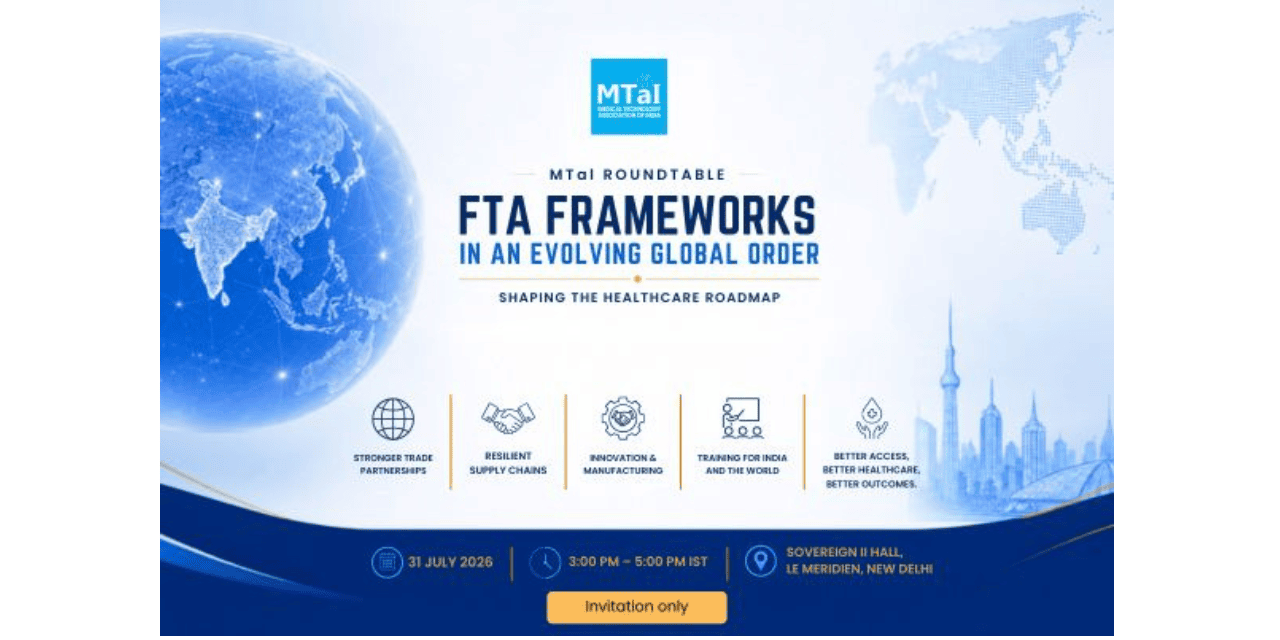
The MedTech Association of India (MTaI) will host a closed-door policy roundtable on July 31, 2026, bringing together senior policymakers, diplomats, regulators, trade experts, and industry leaders to discuss how India’s evolving Free Trade Agreement (FTA) framework can strengthen the country’s medical technology ecosystem and improve access to advanced healthcare solutions.
The roundtable comes at a time when India’s trade landscape is undergoing significant transformation. The India–UK Comprehensive Economic and Trade Agreement (CETA) came into force on July 15, 2026, while the India–EU Free Trade Agreement, concluded in January 2026 after nearly two decades of negotiations, is expected to become operational in the near future.
According to MTaI, the event aims to examine how these agreements can translate into practical opportunities for the MedTech sector by encouraging investment, technology transfer, regulatory cooperation, and resilient healthcare supply chains.
Held under the theme “FTA Frameworks in an Evolving Global Order: Shaping the Healthcare Roadmap,” the invitation-only discussion will focus on the expanding role of FTAs beyond tariff reduction. Participants are expected to deliberate on how modern trade agreements can facilitate investment, support advanced manufacturing, strengthen regulatory convergence, and enable cross-border technology partnerships.
The association stated that the dialogue seeks to develop an evidence-based roadmap to enhance investor confidence in India’s MedTech industry, reduce supply chain vulnerabilities, and attract long-term foreign direct investment (FDI) across research and development, manufacturing, and workforce training.
The roundtable is also part of a series of engagements marking MTaI’s 10th anniversary, reflecting the association’s continued efforts to strengthen collaboration between industry, policymakers, and healthcare stakeholders.
Among the key issues expected to be discussed are the implementation of tariff provisions through timely government notifications, simplified customs procedures, and clear product classification systems to ensure businesses can effectively utilize FTA benefits.
The participants will also examine strategies to reduce non-tariff barriers, with discussions focusing on regulatory harmonization, which industry experts believe often presents a greater challenge to international trade than tariffs themselves.
Another area of discussion will be strengthening investment facilitation and regulatory support through joint monitoring mechanisms, regulator-to-regulator engagement, and structured problem-solving platforms designed to encourage foreign investment, technology transfer, and resilient supply chains.
The dialogue is also expected to address workforce mobility and cross-border services while exploring institutional mechanisms that can ensure FTAs contribute to innovation, manufacturing growth, employment generation, and improved healthcare access.
Commenting on the initiative, Mr. Pavan Choudary, Chairman, MTaI, said:
“Trade policy and healthcare policy are increasingly inseparable. A well-designed FTA framework can accelerate technology transfer, deepen local manufacturing and bring the latest medical innovations to Indian patients faster. This roundtable is an opportunity to translate that shared vision into practical, implementable recommendations for policymakers.”
The discussions are expected to contribute to policy recommendations that support India’s ambition of becoming a trusted global hub for medical technology manufacturing, innovation, and healthcare partnerships.