
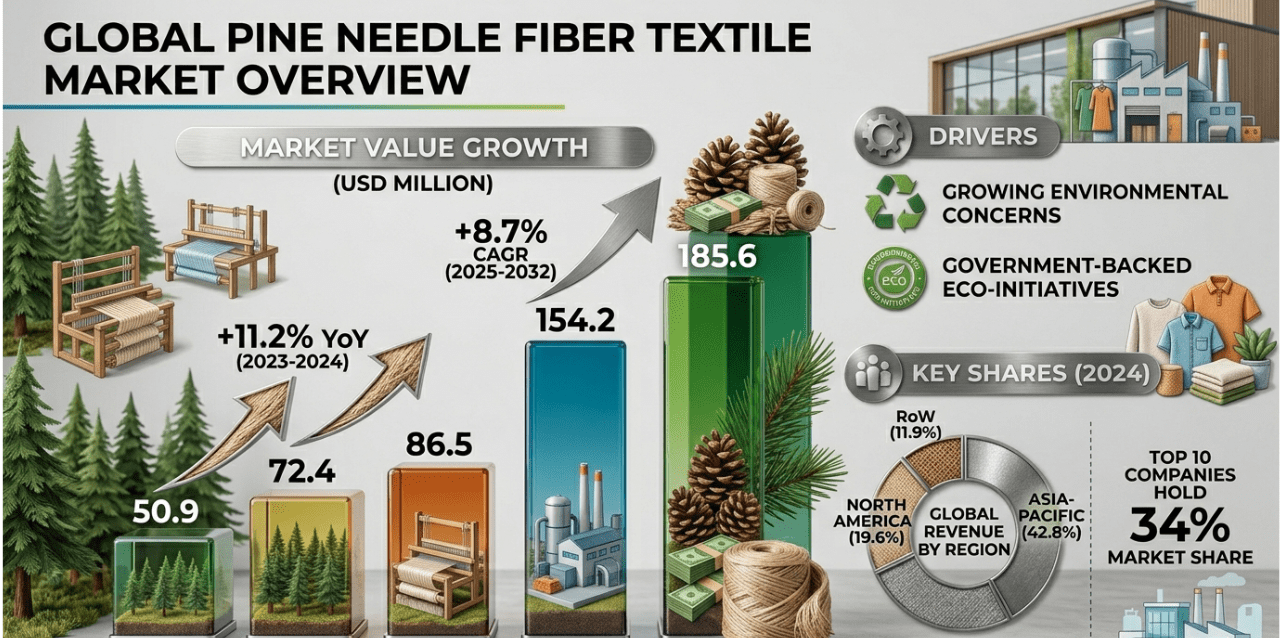
The global Pine Needle Fiber Textile market is gaining momentum as demand for sustainable and biodegradable textile materials continues to grow. According to Marketintelo, the market was valued at USD 72.4 million in 2024, up from USD 65.1 million in 2023, representing an 11.2% year-on-year growth. The market is projected to reach USD 185.6 million by 2032, expanding at a CAGR of 8.7% between 2025 and 2032.
Growing environmental awareness, restrictions on synthetic fibres, and government initiatives supporting eco-friendly textiles are contributing to the market’s steady expansion.
Market Growth Accelerates
The market has more than doubled over the past eight years.
- 2016: USD 34.5 million
- 2018: USD 42.7 million
- 2020: USD 50.9 million
- 2022: USD 58.3 million
- 2023: USD 65.1 million
- 2024: USD 72.4 million
Between 2016 and 2024, the market expanded by nearly 110%, with post-2020 growth driven by increasing adoption of environmentally responsible textile materials.
Annual growth remained consistent over recent years:
- 2020–2021: 9.8%
- 2021–2022: 8.7%
- 2022–2023: 11.6%
- 2023–2024: 11.2%
The average annual growth rate of 10.3% exceeds that of the broader natural fibre textile sector.
Asia-Pacific Leads Global Market
Asia-Pacific accounted for the largest share of the global market in 2024, representing 42.8% of total demand with a market value of USD 31 million.
India and China collectively contribute around 68% of regional production, with India producing approximately 18,000 metric tons of pine needle fibre annually.
Regional market performance includes:
- Asia-Pacific: USD 31 million (42.8% share), CAGR 9.4%
- Europe: USD 18.6 million (25.7% share), CAGR 8.1%
- North America: USD 14.2 million (19.6% share), CAGR 7.9%
- Rest of the World: USD 8.6 million (11.9% share), CAGR 8.3%
Germany and France continue to drive European demand through expanding eco-fashion industries, while the United States accounts for nearly 78% of the North American market.
Government Support Strengthens Industry
Public investment is playing an increasingly important role in market development.
According to the report:
- India allocated USD 12.5 million (₹104 crore) in 2023 for pine needle utilisation programmes.
- Himachal Pradesh processed over 75,000 metric tons of pine needles in 2023, representing a 28% increase from 2021.
- The European Union invested USD 48 million in biodegradable textile research between 2021 and 2024.
- U.S. sustainable textile grants reached USD 22.7 million in 2023, up 18% year-on-year.
These initiatives have helped reduce raw material costs by an estimated 15–20% over the past five years.
Applications Expand Across Textile Segments
Pine needle fibre is increasingly being used across multiple product categories.
Current market distribution includes:
- Apparel – 38%
- Home textiles – 27%
- Industrial textiles – 21%
- Handicrafts and other applications – 14%
Manufacturing efficiency has also improved significantly.
The report highlights:
- Fibre extraction yield increased from 32% in 2018 to 47% in 2024.
- Processing costs declined by 18.6% between 2019 and 2024.
- Production volumes have grown by approximately 9.2% annually.
Industry Remains Highly Innovative
The market remains moderately fragmented, with more than 120 small and medium-sized companies operating globally.
Key industry indicators include:
- Top 10 companies hold 34% of the market.
- Average company revenue increased 12.4% in 2023.
- Research and development spending grew 16.8% year-on-year.
- Start-ups account for 28% of new market entrants since 2020.
Positive Outlook Through 2032
Marketintelo forecasts continued expansion throughout the decade.
Projected market values include:
- 2025: USD 79.1 million
- 2026: USD 86.5 million
- 2027: USD 95.3 million
- 2028: USD 110.2 million
- 2030: USD 154.2 million
- 2032: USD 185.6 million
The market is expected to generate more than USD 106 million in additional value between 2025 and 2032.
Sustainability Trends Continue to Drive Demand
Demand for biodegradable textiles increased by 21.4% globally in 2023, while pine needle fibre exports rose 14.7% year-on-year.
Additional findings indicate:
- Pine needle fibre textiles can reduce carbon footprints by up to 38% compared with synthetic fibres.
- Global consumer preference for eco-friendly textiles reached 64% in 2024.
- Blending pine fibres with cotton has improved fabric durability by approximately 22%, supporting wider commercial adoption.
As sustainability regulations tighten and manufacturers seek renewable raw materials, pine needle fibre textiles are expected to play an increasingly important role in the future of the global textile industry.