Sustainability in Textiles | Textile Industry

From Cotton to Carbon Cuts: Sri Kannapiran Mills’ Green Drive

Published: September 13, 2025
Author: HFT

Before ESG became a corporate trend, Sri Kannapiran Mills was already practicing it. As part of the heritage-rich KG Group, this Coimbatore-based powerhouse is not just producing yarn—it is redefining standards in circular manufacturing, energy efficiency, and climate-conscious investment.

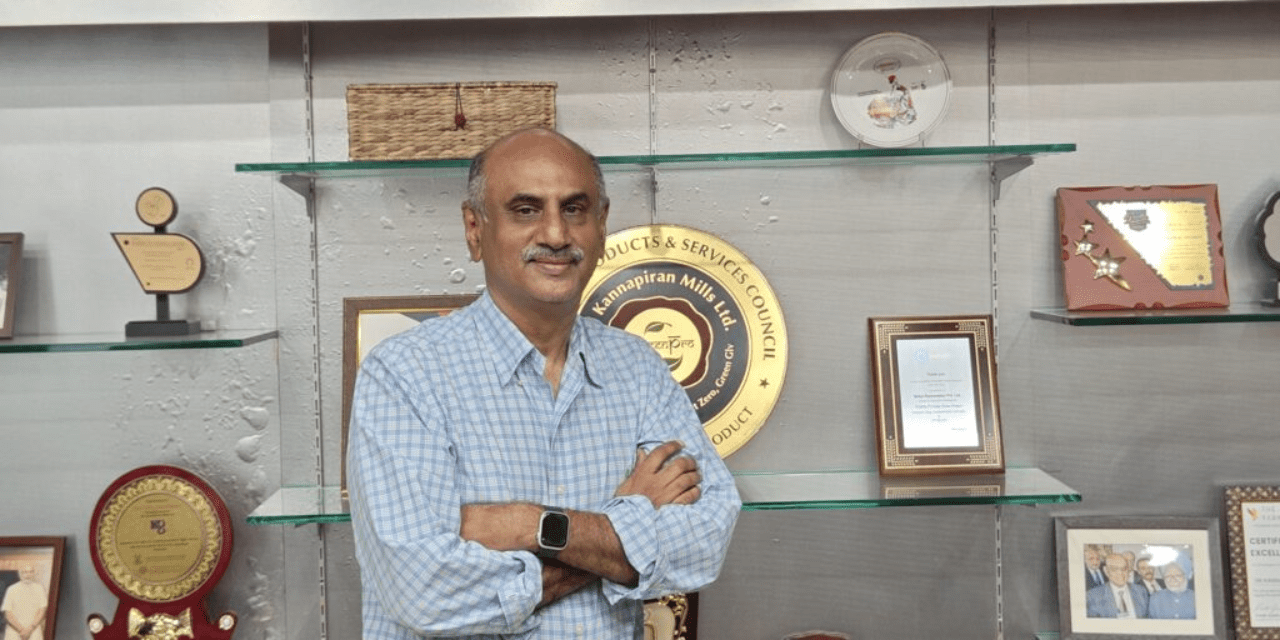
Srihari Balakrishnan, Managing Director
With sustainability ingrained into its DNA long before it became fashionable, Sri Kannapiran Mills has built a model that many competitors now aspire to follow. “We don’t retrofit sustainability—we design for it,” says Managing Director Srihari Balakrishnan, whose forward-looking leadership has turned the company into a benchmark for clean, smart textile production.
High-Performance Yarn Specialist
Operating 55,200 spindles and 8,600 rotors, the mill does far more than produce cotton yarn—it engineers it. “We are known for precision counts,” Srihari explains. From 4s to 80s, both OE and ring-spun yarns roll out to serve denim, innerwear, home textiles, and specialty fabric segments.

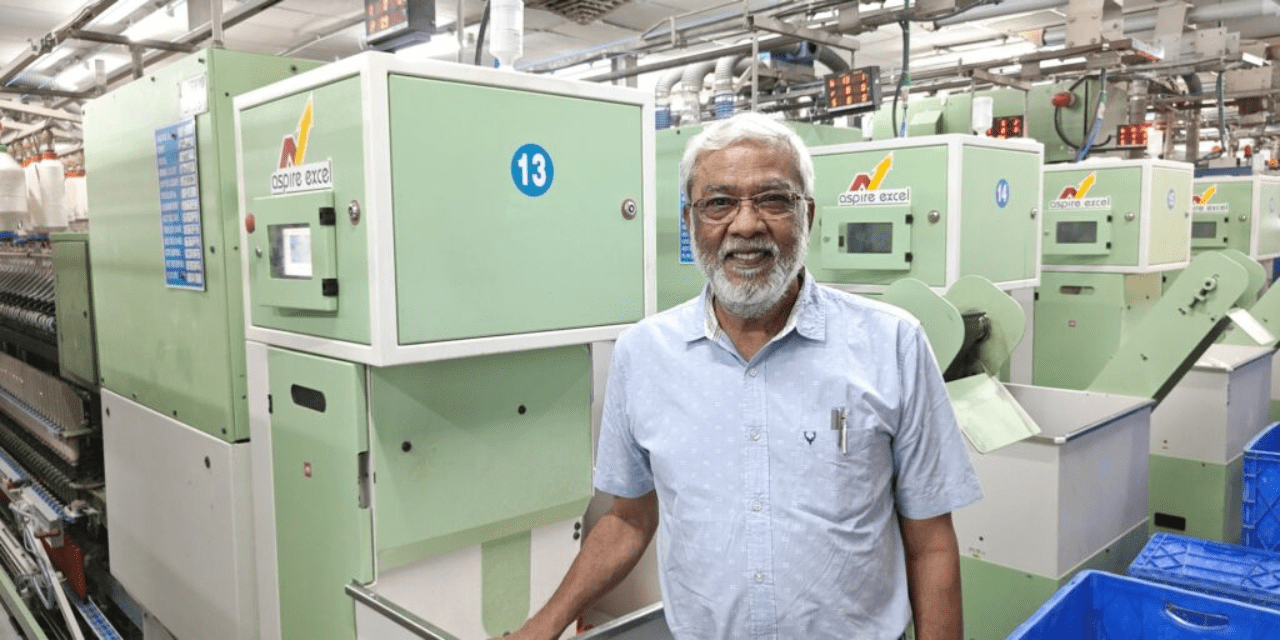
R. Seenivasahan, Vice President, Kannapiran Mills
The company’s offerings extend to gassed mercerized, compact, slub, multicount, corespun, and indigo-dyed yarns, along with thermal blankets, gloves, and bleached bath linens. With six facilities—four spinning units in Coimbatore, plus weaving and value-addition units—the company’s integrated operations are both deep and wide.
Green Before It Was Cool
Well before carbon audits became standard, Sri Kannapiran Mills was rethinking waste. “We operate on a zero-waste philosophy,” says Srihari. “From every 100 kg of cotton, 94 kg becomes yarn—among the best conversion rates in India. The rest? Gloves, lamp wicks, coarse yarns, even cattle feed and manure.” Even bale wrappers are reused—showing a level of efficiency rarely seen in Indian textiles.

Each process is analyzed for energy efficiency and waste management. The Perundurai weaving unit, GreenCo certified by CII, meets benchmarks in water conservation, emissions, and resource recovery.

Precision Investment: Powered by Good Fashion Fund
In a clear example of responsible growth, Sri Kannapiran Mills secured $2.5 million from the Good Fashion Fund—backed by Laudes Foundation and Fashion for Good—to replace old machinery with efficient, low-impact technology.

“Every rupee is deployed like a surgical strike,” notes Srihari. “We test, validate, then scale.” That strategy worked with a new singeing machine at the weaving unit. Switching from combed to carded yarn boosted productivity so dramatically that the investment paid back in just two days.

Sustainability ≠ Solar Panels Alone
While the company does source renewable energy from wind and solar, Srihari emphasizes discipline over mere infrastructure. “You can install the best solar plant, but without operational rigor—especially in maintenance—it falls apart. Sustainability is not plug-and-play. It’s a culture.”

This culture ensures that economic performance, environmental impact, and operational efficiency are measured together. “That’s real ESG. Not a PowerPoint slide—an operational reality.”

Diversification: Weaving into the Future
Confronted with rising input costs and global pricing pressures, the company is expanding weaving operations. “Pure spinning is no longer a viable standalone business,” Srihari explains. “Weaving gives us vertical integration and margin protection.”

However, geopolitical uncertainties and tariff issues complicate planning. “Planning used to be 12 months ahead. Now we’re forced to think in quarters, even weeks. It’s a volatile world.” Despite this, he remains cautiously optimistic: “The UK-India FTA is a good signal. Similar deals with the US and EU could truly unlock India’s garment potential.”

MMF: Still a Roadblock
On the subject of man-made fibers (MMF), Srihari stays pragmatic. “India’s MMF ecosystem is chaotic. High duties, raw material costs, and supply chain friction make it uncompetitive. Until the policy landscape changes, MMF will struggle to scale.”

He sums it up with characteristic clarity: “There’s too much entropy in MMF. We need to turn that into energy—literally and metaphorically.”

Related Posts

PUNO Unveils Pune's First Social Zone at PUNO Advance

Inflow Technologies Announces Strategic Partnership with Ensurity to Enhance Cyber Security Solutions in India