
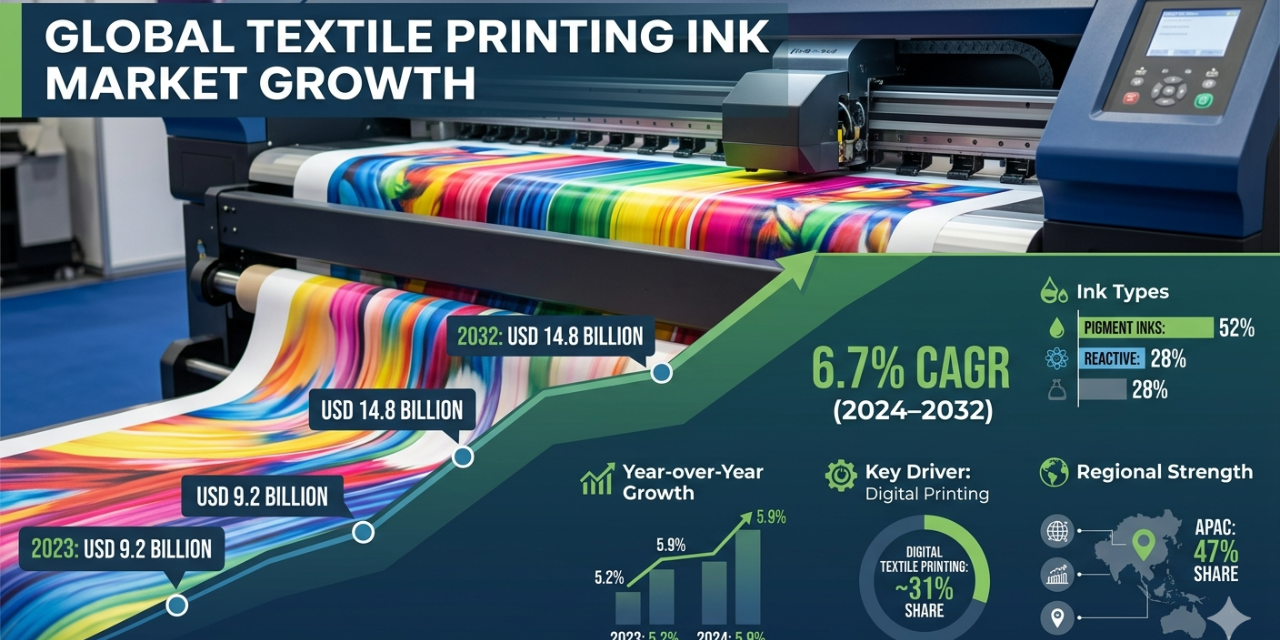
The global textile printing ink market is on a steady growth trajectory, driven by rising demand for digital textile printing, increasing adoption of sustainable ink solutions, and expanding global apparel consumption. According to insights by Marketintelo, the market was valued at USD 9.2 billion in 2023 and is projected to reach USD 14.8 billion by 2032, registering a CAGR of 6.7% from 2024 to 2032.
The market has shown consistent year-on-year growth, with a 5.9% increase in 2024, up from 5.2% in 2023 and 4.8% in 2022. This upward trend highlights the accelerating shift toward eco-friendly and digitally compatible ink technologies.
Market Evolution and Growth Trends
Over the past decade, the textile printing ink industry has expanded significantly, supported by advancements in pigment technologies and water-based formulations. The market grew from USD 6.1 billion in 2016 to USD 9.2 billion in 2023, adding over USD 3 billion in value.
Digital textile printing has gained strong momentum, with penetration increasing from 18% in 2020 to an expected 31% by 2025. Meanwhile, water-based inks now account for 62% of the total market, reflecting the industry’s shift toward environmentally responsible solutions.
Segment Insights
By ink type, pigment inks dominate with a 52% share, followed by reactive inks at 28%. Sublimation inks are also gaining traction, particularly due to the rising use of polyester fabrics.
In terms of technology, screen printing still holds the largest share at 54%, while digital printing has reached 31% and is expected to exceed 40% by 2030, growing at a faster pace than traditional methods.
Regional Market Dynamics
Asia-Pacific leads the global market with a 47% share, valued at USD 4.6 billion in 2024. The region’s growth is driven by strong textile manufacturing bases in countries like China and India.
North America and Europe follow, with stable growth supported by increasing adoption of digital printing technologies and sustainable practices. Meanwhile, Latin America and the Middle East & Africa are witnessing gradual expansion due to emerging textile hubs and industrial investments.
Investment and Sustainability Trends
Global investments in digital textile printing technologies reached USD 1.4 billion in 2023, marking an 18% increase year-on-year. Additionally, eco-friendly ink production has grown by 22%, reflecting strong industry commitment to sustainability.
Manufacturers are also increasing R&D spending, allocating around 6–8% of annual revenues to innovation. Government support, particularly in Asia, has further accelerated industry development, with incentives exceeding USD 12 billion between 2021 and 2024.
Key Growth Drivers and Challenges
The market is being propelled by rising demand for customized apparel, rapid growth in e-commerce fashion sales, and increasing use of polyester fabrics. However, challenges such as higher environmental compliance costs, raw material price volatility, and rising wastewater treatment expenses continue to impact the industry.
Future Outlook
The textile printing ink market is expected to maintain strong momentum through 2032, supported by digital transformation and sustainability initiatives. Digital inks are forecast to grow at a CAGR of 9.2%, while eco-friendly inks are expected to increase their market share to 74% by 2032.
With global consumption projected to reach 3.9 million tons by 2032 and Asia-Pacific maintaining its leadership position, the industry is undergoing a structural shift toward more efficient, sustainable, and technology-driven solutions.