
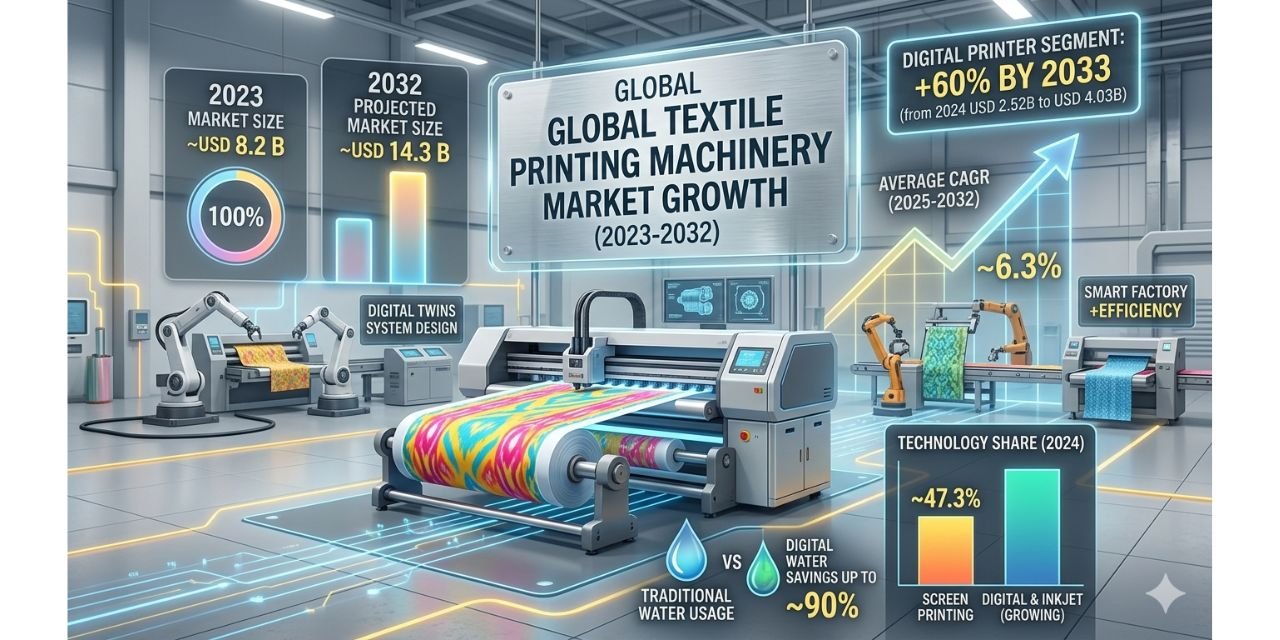
The global textile printing machinery market continues to play a vital role in modern textile manufacturing, supporting applications across apparel, home textiles, and technical fabrics. According to Dataintelo, the market was valued at approximately USD 8.2 billion in 2023 and is projected to reach around USD 14.3 billion by 2032, growing at a CAGR of nearly 6.3% between 2025 and 2032.
This growth reflects a broader transformation in the industry, driven by technological advancements, cost efficiencies, and sustainability requirements.
Key Statistics at a Glance (2021–2033)
| Metric | Value | Context |
|---|---|---|
| 2023 Market Size (Global Machinery) | ~USD 8.2 B | Base comparison year (Dataintelo) |
| 2032 Projected Market Size | ~USD 14.3 billion | Forecast total value |
| Average CAGR (2025–2032) | ~6.3 % | Growth pace forecast |
| Textile Printing Market (All Processes) | USD 25.8 bn (2024) | Broader industry size |
| Projected Textile Printing Market (2033) | USD 56.7 bn | Forecast for total segment |
| Digital Printer Segment Value (2024) | USD 2.52 bn | Digital printing specifically |
| Digital Printer Forecast (2033) | USD 4.03 bn | Future value |
| Asia Pacific Market Share (2024) | ~37.6 % | Largest regional share |
| Screen Printing Share (2024) | ~47.3 % | Largest technology share |
| Roll-to-Roll Printing Share (2024) | ~66.9 % | Top digital process share |
| Water Saving with Digital vs. Traditional | Up to ~90 % | Efficiency improvement |
Market Growth & Regional Trends
Between 2021 and 2026, the market has shown steady expansion. Machinery sales stood at approximately USD 8.2 billion in 2023, while the broader textile printing industry reached USD 25.8 billion in 2024.
By 2032, machinery demand is expected to increase by nearly 74% compared to 2023 levels, highlighting strong long-term growth potential.
Regionally, Asia Pacific dominates the market, accounting for around 37.6% share in 2024, with a similar share in digital printing adoption. Meanwhile, the U.S. and Europe continue to invest heavily in automation and advanced printing technologies.
Technology Landscape & Efficiency Gains
Screen printing remains the leading technology, holding about 47.3% market share, while digital and inkjet printing systems are witnessing rapid adoption due to rising demand for customization and shorter production cycles.
Within digital printing, roll-to-roll systems lead with nearly 66.9% share, making them the most widely used process.
A major advantage of digital textile printing is its sustainability performance. Compared to traditional methods, digital printing can reduce water consumption by up to 90%, making it highly attractive in regions with strict environmental regulations.
Cost Structure & ROI Insights
Investment in textile printing machinery varies significantly depending on technology:
- Traditional screen printing units: ~USD 150,000–250,000+
- Advanced digital printers (single-pass): ~USD 300,000–500,000+
- High-throughput digital printers (multi-pass): ~USD 800,000–1.2 million+
From a return on investment perspective, mid-sized garment manufacturers adopting digital printing solutions can achieve 25–45% reduction in per-unit printing costs within two years, depending on operational scale and efficiency.
Expanding Application Areas
Textile printing machinery is widely used across multiple segments:
- Garments & Apparel: The largest segment, accounting for over 40% of global deployments
- Home Textiles: Increasing demand in curtains, upholstery, and décor fabrics
- Technical Textiles: Growing applications in automotive, healthcare, and industrial sectors
Future Outlook & Industry Direction
The outlook for the textile printing machinery market remains positive, with digital printing expected to play a central role in future growth.
- The digital textile printing segment is projected to grow from USD 2.52 billion in 2024 to USD 4.03 billion by 2033, marking an increase of nearly 60%
- Digital technologies are expected to account for an additional 15–25% share of total printing deployments by 2030
These trends indicate a shift toward more efficient, automated, and environmentally sustainable production systems.
Operational Benefits of Modern Machinery
Upgrading to advanced printing technologies offers measurable advantages:
- 30–50% faster production speeds for complex designs
- Up to 90% reduction in water consumption
- 30–60% decrease in material waste for short production runs
Conclusion
The textile printing machinery market is undergoing a significant transformation, supported by strong growth projections and technological innovation.
With market value expected to rise from USD 8.2 billion in 2023 to approximately USD 14.3 billion by 2032, and digital printing expanding rapidly, the industry is clearly moving toward a future defined by efficiency, sustainability, and high-performance manufacturing.