
Global Textile Waste Reaches 92 Million Tons as Recycling Gap Highlights Circular Economy Challenge
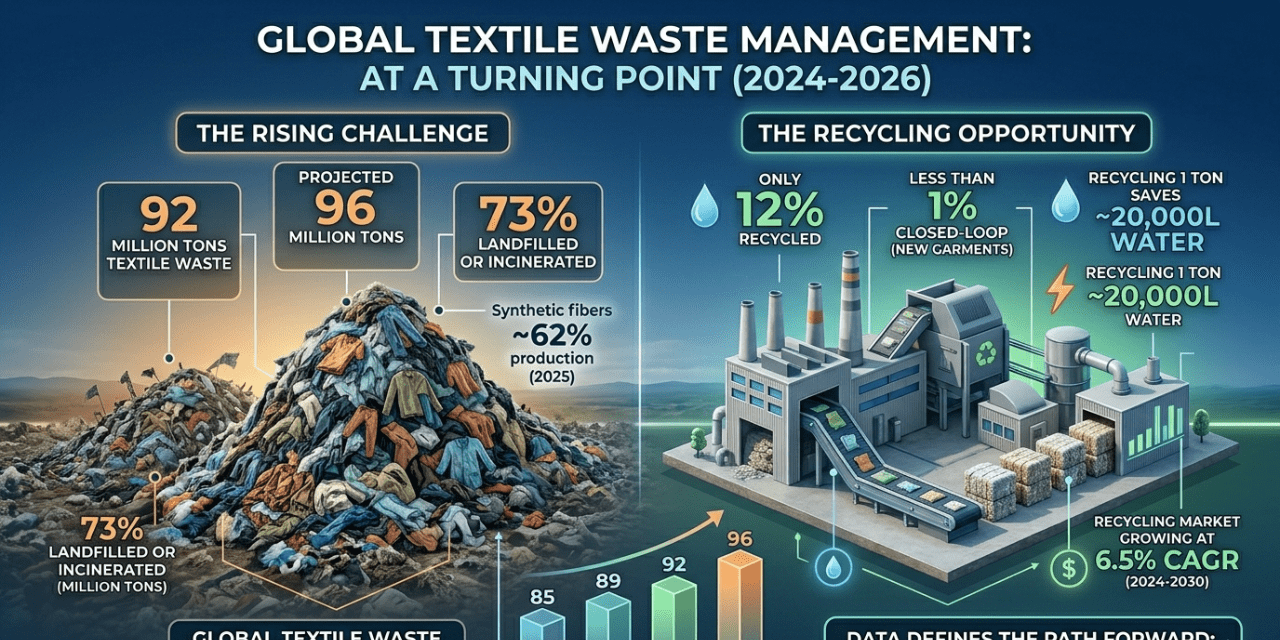
The global textile industry is facing mounting environmental and economic pressure as textile waste continues to rise, reinforcing the need for stronger recycling infrastructure and circular production models. According to recent market intelligence from Dataintelo, global textile waste reached 92 million tons in 2024 and is projected to increase to 96 million tons by 2026, reflecting the growing impact of rising apparel consumption and limited recycling capacity.
Despite increased awareness around sustainability, the report notes that 73% of textile waste is still sent to landfills or incinerated, while only 12% is recycled. Of that, less than 1% is recycled into new garments through closed-loop systems, highlighting the industry’s ongoing recycling challenges.
Fast Fashion and Synthetic Fibres Drive Waste Growth
Between 2020 and 2026, global textile waste is expected to grow by approximately 13%, increasing from 85 million tons to 96 million tons.
Several factors continue to contribute to this trend:
- Clothing production has doubled since 2000, while average garment usage has declined by nearly 50%.
- Around 85% of discarded textiles are thrown away rather than reused.
- Synthetic fibres account for approximately 62% of global fibre production, with polyester alone reaching around 70 million tons in 2025.
- Many blended fabrics remain difficult to recycle due to current technological limitations.
- Only 25–30% of countries currently have formal textile recycling systems in place.
Significant Environmental Impact
The textile industry’s environmental footprint remains substantial.
According to the report:
- The sector contributes approximately 1.2 billion tons of CO₂ emissions annually, representing nearly 10% of global emissions.
- Producing a single cotton shirt requires around 2,700 litres of water.
- Textile dyeing contributes roughly 20% of industrial water pollution worldwide.
- Textile waste accounts for approximately 5% of landfill volume, while decomposing textiles generate methane emissions with significantly higher global warming potential than carbon dioxide.
- Around 35% of ocean microplastics originate from synthetic textiles.
Recycling Offers Long-Term Benefits
Although recycling remains more expensive than landfill disposal, the report highlights several long-term advantages.
Mechanical recycling costs between US$120 and US$180 per ton, while chemical recycling ranges from US$200 to US$350 per ton, compared with landfill disposal costs of US$75–100 per ton.
However, recycling can:
- Save approximately 20,000–25,000 litres of water per ton.
- Reduce carbon emissions by around 3.6 tons of CO₂ per ton recycled.
- Lower energy consumption by 70–90%.
- Generate US$500–1,000 in value per ton of recycled textiles.
- Create 20–30 jobs for every 1,000 tons of textile waste processed.
Recycling Market Continues to Expand
The global textile recycling market is forecast to grow steadily.
The report estimates market value at:
- US$7.5 billion in 2024
- US$8.6 billion in 2026
- US$11.2 billion by 2030
representing a compound annual growth rate (CAGR) of 6.5% between 2024 and 2030.
Among regions, Asia-Pacific is expected to record the fastest growth at 8.4% CAGR, followed by Europe (7.2%) and North America (6.1%).
Industry Outlook
Looking ahead, textile waste is projected to reach 110 million tons by 2030 if current consumption trends continue.
The report suggests that increasing recycling rates from the current 12% to between 25% and 30%, combined with AI-powered sorting technologies and broader circular economy initiatives, could substantially reduce waste generation while improving resource efficiency.
As regulatory pressure and sustainability commitments continue to grow across the global textile and fashion industries, investment in advanced recycling technologies, material innovation and circular business models is expected to play an increasingly important role in reducing textile waste and supporting long-term industry transformation.


