
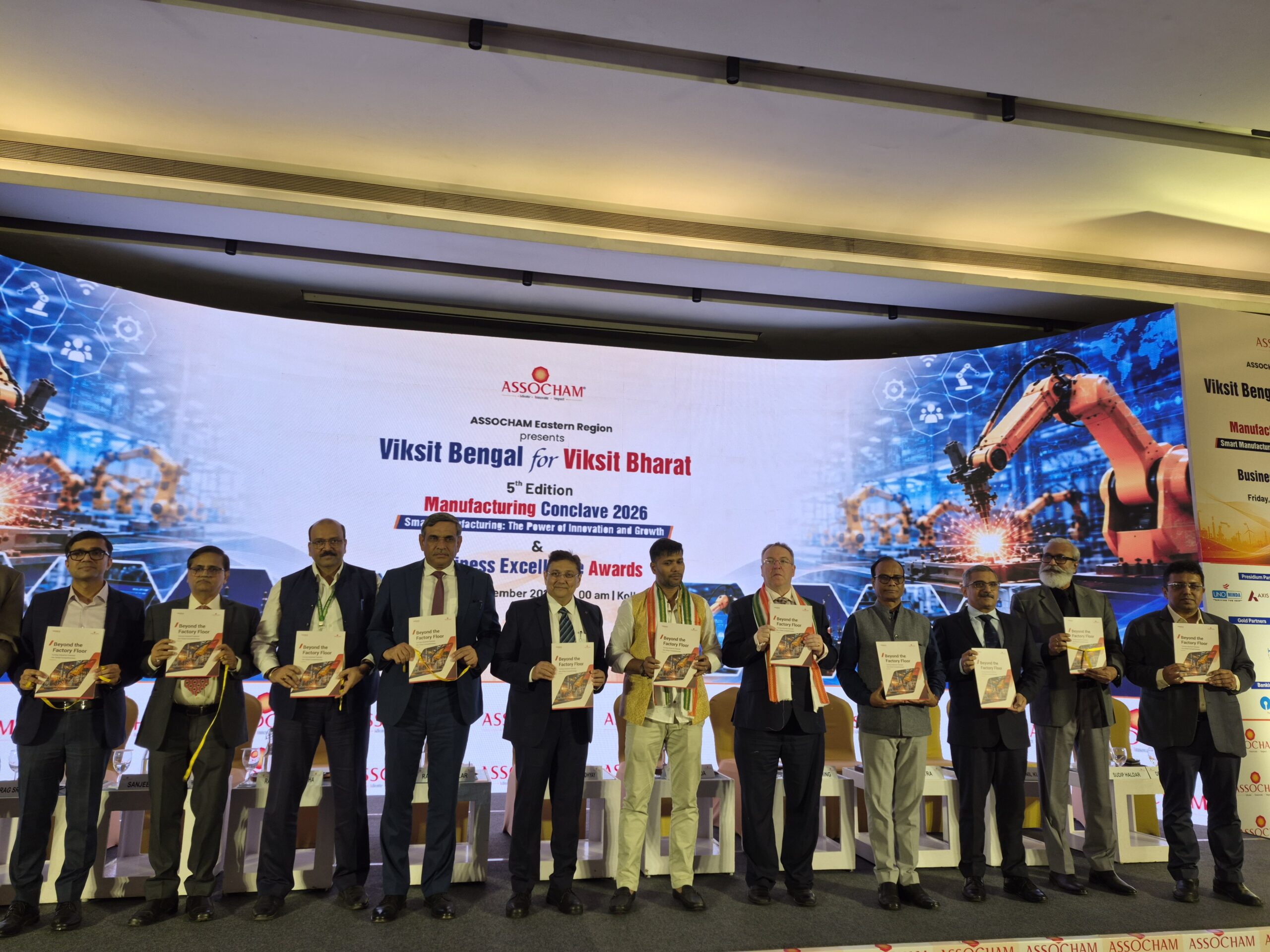
West Bengal has significant potential to emerge as a major manufacturing and export hub in Eastern India, according to a new report by Primus Partners and ASSOCHAM. The report highlights the state’s industrial diversity, established manufacturing clusters and strategic connectivity as important strengths.
Titled Beyond the Factory Floor: Turning Industrial Potential into Global Competitiveness, the report outlines 10 recommendations to strengthen West Bengal’s manufacturing sector and improve its global competitiveness.
Released on November 20, 2026, the report examines India’s changing manufacturing landscape and the opportunities available in Eastern India. It calls for a shift towards higher value addition, advanced technology, improved productivity and stronger participation in global manufacturing networks.
Eastern India Offers Manufacturing Growth Opportunities
West Bengal, Odisha and Jharkhand collectively recorded manufacturing Gross State Value Added (GSVA) of approximately ₹4.50 lakh crore in FY 2024–25. Maharashtra recorded ₹5.42 lakh crore during the same period.
The three eastern states bring complementary industrial strengths. Odisha and Jharkhand have established resource-based industries, particularly in metals and minerals. Meanwhile, West Bengal offers a diversified industrial base, manufacturing clusters and strategic connectivity.
Devroop Dhar, Co-Founder and Managing Director of Primus Partners, said industrial progress depends on more than attracting investments. He highlighted the importance of investment-ready infrastructure, regulatory efficiency, cluster modernisation, enterprise development and workforce capabilities.
West Bengal Faces Manufacturing and Export Challenges
Despite its industrial legacy and geographical advantages, West Bengal faces several structural challenges.
The state’s share of India’s GDP declined from 10.5% in 1960–61 to approximately 5.5% in 2024–25. It also accounted for just 2.9% of India’s merchandise exports in FY26. Furthermore, its ten leading export products contributed 61.3% of the state’s export basket.
The report identifies opportunities across several established industries, including metals, refining, chemicals, engineering, foundries, textiles, leather, jute and food processing.
Emerging sectors such as defence manufacturing, shipbuilding, ship repair, advanced engineering and downstream chemicals could further diversify the state’s industrial base.
West Bengal also benefits from its proximity to resource-rich regions, ports and inland waterways. Its MSME network, engineering institutions and research capabilities provide additional support for industrial expansion.
Developments in Haldia, gas infrastructure, waterways and industrial corridors could also encourage new manufacturing clusters and downstream industries.
10 Recommendations to Strengthen Manufacturing
The report outlines 10 strategic interventions to improve West Bengal’s manufacturing ecosystem.
1. Strengthening Industrial Competitiveness: Implement the new Industrial Policy effectively and improve the reliability of investment incentives.
2. Modernising Manufacturing Clusters: Develop integrated industrial ecosystems with shared design, technology, testing and certification facilities.
3. Expanding Investment-Ready Infrastructure: Strengthen industrial land banks, encourage private industrial parks and develop plug-and-play facilities.
4. Developing Sector-Specific Industrial Parks: Prioritise defence, shipbuilding, advanced engineering, electronics, chemicals, pharmaceuticals, food processing and textiles.
5. Improving Investment Facilitation: Strengthen Silpa Sathi through GIS-enabled land information, AI-powered investor assistance and digital processing.
6. Creating a Business-Friendly Regulatory Environment: Simplify compliance procedures, improve approval timelines and strengthen coordination between departments.
7. Enhancing MSME Competitiveness: Improve access to global markets, technology partnerships, supplier development and quality certification.
8. Building a Skilled Manufacturing Workforce: Expand industry–ITI partnerships, apprenticeships, work-based learning and continuous skill development.
9. Strengthening Manufacturing Quality: Expand common testing, calibration and metrology facilities while promoting internationally accepted quality standards.
10. Repositioning West Bengal as an Investment Destination: Promote the state through a unified investment proposition under the banner “Make in Bengal. Build for the World.”
Coordinated Industrial Development Can Support Global Competitiveness
The report emphasises that West Bengal’s manufacturing ambitions must go beyond attracting individual investments. The state needs a coordinated approach that connects industrial policy with investment execution and infrastructure development with enterprise productivity.
Stronger local supply chains, modern manufacturing clusters and sector-specific development could help generate higher-value industrial output and sustainable employment.
By building on its existing industrial strengths and improving the wider manufacturing ecosystem, West Bengal has an opportunity to strengthen its position in India’s manufacturing growth and expand its participation in global markets.


