
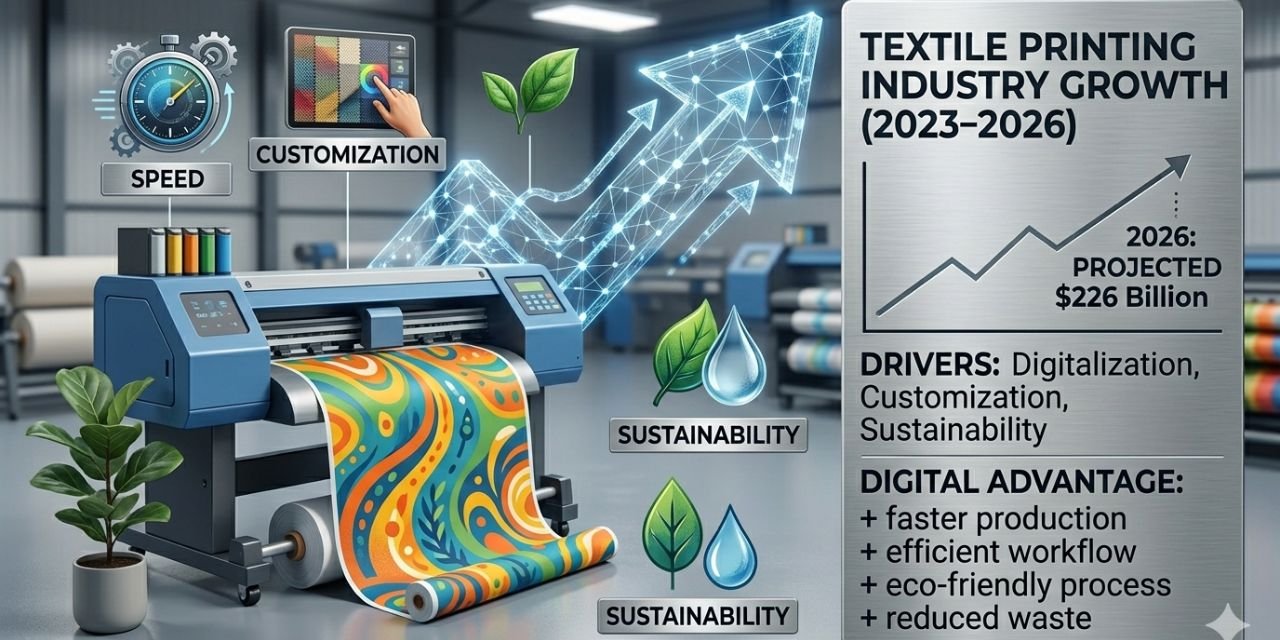
The global textile printing industry is undergoing a major transformation between 2023 and 2026, fueled by digitalization, rising demand for customization, and increasing focus on sustainability. According to insights from Dataintelo, the market continues to expand steadily across segments.
The industry, valued at around $25.8 billion in 2024, is projected to reach $27.9 billion in 2025, reflecting an annual growth of over 8%. Looking further ahead, the market is expected to grow at a 9.3% CAGR through 2033, potentially reaching $56.7 billion.
At a broader level, the textile printing sector is forecast to grow from $178 billion in 2023 to $226 billion by 2026, marking a 27% increase driven by demand for short-run production and personalization.
Digital Printing Drives Industry Evolution
Digital textile printing is emerging as the key growth engine, expected to expand from $31 billion in 2023 to $42 billion by 2026. Its increasing adoption is backed by clear performance advantages:
- Cost efficiency: Setup costs are reduced by 60–70%, with small-batch savings of up to 25% per unit
- Faster production: Lead times shrink from 7–10 days to just 2–4 days
- Lower waste: Fabric waste drops by up to 20%, and ink waste by 30%
- Customization: Demand for personalized textiles has surged by 45%
- Sustainability: Water consumption is reduced by up to 90%, with lower carbon emissions
As a result, digital printing’s market share has increased to 38% in 2025, up from 29% in 2018, while traditional analog printing continues to decline.
Regional Growth Trends
Asia-Pacific dominates the global textile printing landscape, accounting for 47% of market share, led by countries like India, China, and Bangladesh.
- Europe: 26% share, driven by sustainability regulations
- North America: 19% share, supported by high digital adoption
India is emerging as a high-growth market, with an expected CAGR of 11.2%, outpacing the global average.
Investment vs Returns in Digital Printing
Although digital printing requires initial investments ranging from $25,000 to $300,000, the returns are compelling:
- ROI achieved within 18–24 months
- Profit margins increase by 12–20%
- Operational costs reduced by 15–28%
Real-world examples show that companies adopting digital printing can significantly boost productivity, reduce turnaround times, and improve revenue growth within a short period.
Sustainability Becomes a Key Metric
Sustainability is now measurable and critical to business success:
- Over 50% of manufacturers use eco-friendly inks
- Water savings can reach 1.5 million liters annually per factory
- Energy consumption drops by up to 15%
- Wastewater pollution reduced by 70%
While compliance costs have risen slightly, companies embracing sustainable practices benefit from stronger brand perception and long-term gains.
Challenges and Future Outlook
Despite strong growth, the industry faces challenges such as high upfront investment, skilled labor shortages, and fluctuating ink costs. However, future projections remain optimistic:
- Market expected to reach $310 billion by 2030
- Digital printing share projected to exceed 50%
- AI-driven automation and smart textiles expected to grow rapidly
Conclusion
The textile printing industry is entering a data-driven era defined by efficiency, sustainability, and customization. With measurable benefits such as cost savings, faster production, and reduced waste, digital printing is reshaping the competitive landscape.
Companies that invest in advanced technologies and sustainable practices are set to lead the next phase of growth in this evolving industry.