
Global Recycled Plastics Market Set to Reach USD 145.26 Billion by 2034 as Sustainability Drives Demand
Industry Outlook
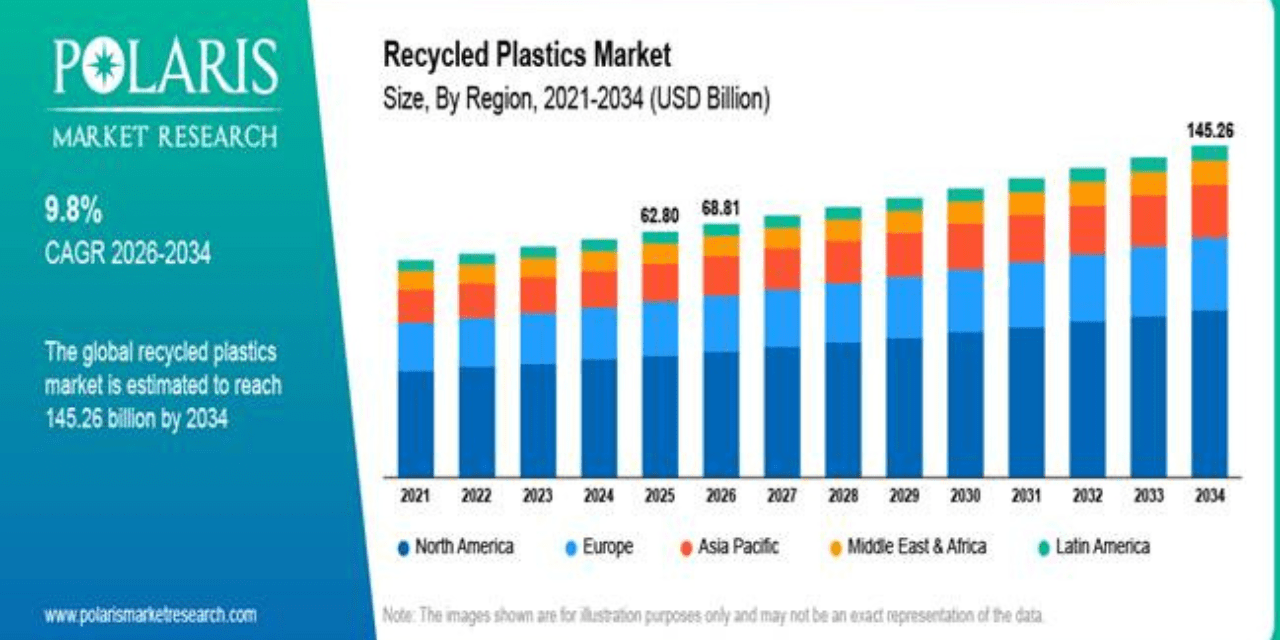
The global recycled plastics market is projected to expand significantly over the coming decade, supported by stricter environmental regulations, corporate sustainability commitments and advancements in recycling technologies. According to market estimates, the industry is expected to grow from USD 68.81 billion in 2026 to USD 145.26 billion by 2034, registering a compound annual growth rate (CAGR) of 9.8% during the forecast period.
Regulations Continue to Shape Market Growth
Government policies remain a key driver of recycled plastics adoption worldwide. Regulatory measures such as the European Union’s plastic tax on non-recycled packaging, the United Kingdom’s levy on plastic packaging containing less than 30% recycled content, and California’s recycled PET requirements have encouraged manufacturers to increase the use of recycled materials.
These policies are accelerating the transition from virgin plastics to post-consumer recycled (PCR) and post-industrial recycled (PIR) plastics across multiple industries.
Corporate Sustainability Initiatives Add Momentum
Beyond regulations, multinational companies across food and beverage, FMCG, automotive and e-commerce sectors continue to increase demand for recycled plastics through voluntary sustainability commitments.
One example cited in the report is the May 2022 partnership between Trioworld and Lidl Sweden, which introduced post-consumer recycled plastic film for frozen food packaging.
PET Emerges as the Leading Material
Among various recycled polymers, polyethylene terephthalate (PET) is expected to record the strongest growth during the forecast period.
The report attributes this trend to increasing demand from food and beverage packaging, bottle-to-bottle recycling initiatives and improved decontamination technologies that enable food-grade recycled PET production.
Other major recycled plastic categories include:
- Polyethylene (PE)
- Polyvinyl chloride (PVC)
- Polypropylene (PP)
- Polystyrene (PS)
Bottle Waste Remains the Largest Feedstock
Plastic bottles continue to represent the largest source segment for recycled plastics because of their standardized material composition and well-developed collection systems.
Plastic films are emerging as a growth opportunity, although wider adoption will depend on expanding collection and sorting infrastructure.
Mechanical Recycling Leads While Chemical Recycling Expands
Mechanical recycling remains the dominant processing method for clean plastic waste streams.
At the same time, chemical recycling technologies are gaining commercial traction for more complex plastic waste. The report highlights several recent developments, including:
- June 2025: INEOS Olefins & Polymers Europe launched recycled plastic production at its Lavera facility using pyrolysis oil.
- January 2025: Loop Industries signed a USD 20.8 million technology licensing agreement for its depolymerization platform in Europe.
- March 2025: Versalis opened a new mechanically recycled plastics production facility in Porto Marghera.
Packaging Continues to Dominate End-Use Demand
Packaging remains the largest application segment for recycled plastics, supported by demand from:
- Food and beverage packaging
- Consumer goods
- E-commerce packaging
The automotive industry is also increasing the use of recycled plastics in lightweight vehicle components, while construction and textile applications continue to expand.
Asia Pacific Maintains Market Leadership
Asia Pacific accounted for the largest share of the recycled plastics market in 2025, supported by expanding manufacturing capacity, urbanisation and government-backed recycling initiatives.
India is expected to register one of the fastest growth rates through 2034, driven by:
- Rapid urbanisation
- Higher packaged goods consumption
- Government support for recycling infrastructure
- The 2021 Plastics Pact, which promotes a circular plastics economy
North America is also projected to witness significant growth as Extended Producer Responsibility (EPR) legislation expands and investments in domestic recycling facilities increase.
Industry Consolidation Continues
The competitive landscape includes established materials companies, recyclers and technology providers such as:
- Indorama Ventures
- Alpek S.A.B. de C.V.
- Biffa plc
- Plastipak Holdings
- Veolia Polymers
- KW Plastics
- Envision Plastics Industries
- Green Line Polymers
- Republic Services
- Stericycle
- SUEZ
Recent acquisitions and investments indicate continued consolidation as companies expand recycling capacity and technology capabilities.
Challenges Remain
Despite strong growth prospects, the market continues to face challenges including:
- High sorting and processing costs
- Feedstock contamination
- Limited collection infrastructure for mixed plastic waste
- Capital investment requirements for advanced recycling technologies
These factors continue to influence the pace of recycled plastics adoption across industries.
Market Outlook
The recycled plastics industry is expected to benefit from the combined impact of environmental regulations, corporate sustainability goals and technological innovation over the forecast period. As industries increasingly adopt circular economy practices, demand for recycled materials is expected to continue rising across packaging, automotive, construction and consumer goods sectors.


