
Bharat Tex 2026: NIFT Session Calls for Durable Fashion to Reach $350 Billion Goal
India’s ambition to build a $350 billion textile industry by 2030 will require a shift from fast fashion to durable and responsible consumption, experts said during a NIFT knowledge session at Bharat Tex 2026.
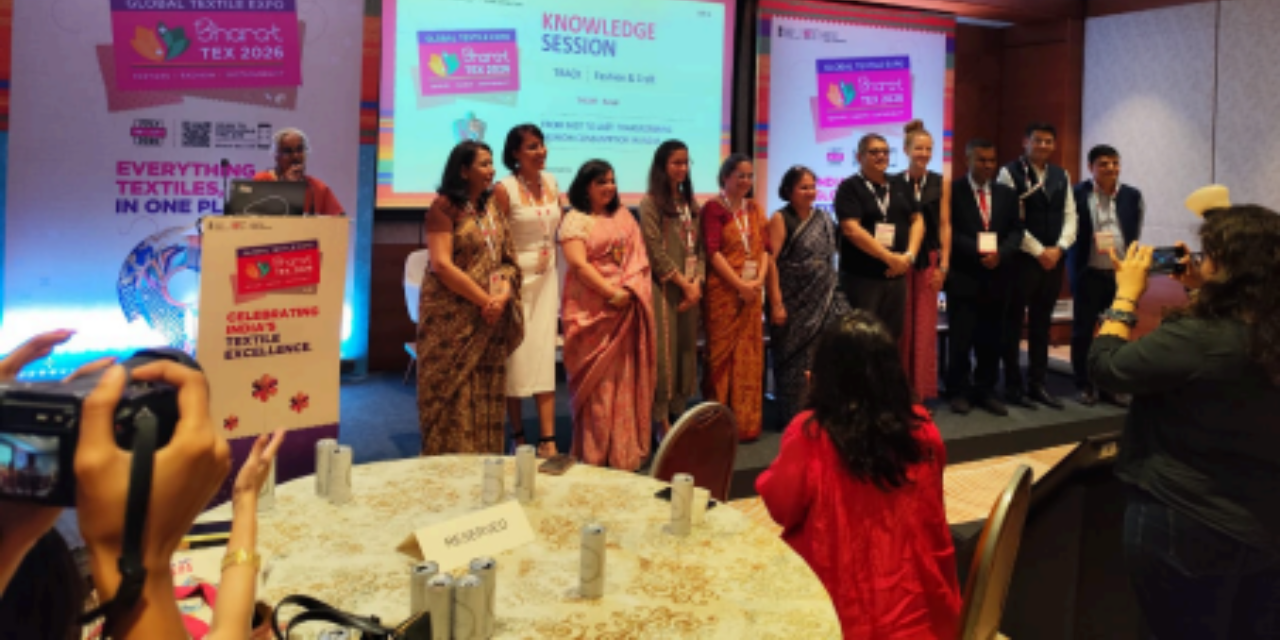
Titled From Fast to Last: Transforming Fashion Consumption in India, the session was held under the UNIDO–Ministry of Textiles project on eliminating hazardous chemicals from the textile and fashion supply chain. The discussion focused on the need for shared responsibility across the value chain, stronger policy implementation and the revival of India’s traditional reuse practices.
Dr. Patsy Perry, Reader in Sustainable Fashion at Manchester Metropolitan University, UK, highlighted the growing challenge of post-consumer textile waste. While 97% of pre-consumer waste is already recycled globally, she said solid waste and post-consumer waste management remain major concerns.
Dr. Naresh Tyagi, President, CITI, pointed to the gap between fashion brands’ emphasis on glamour and a manufacturing ecosystem driven by low-cost production. Dr. Raj Kishore Nayak, Professor at RMIT University Vietnam, called for greater focus on garment durability and proper care labelling.
The panel also identified policy as a key driver of change. Dr. Nayak said policymakers could play a significant role in enforcing Extended Producer Responsibility (EPR) and regulations similar to the EU’s Ecodesign for Sustainable Products Regulation (ESPR).
Kumar Priyadarshi highlighted the demand for durable products in smaller Indian towns and pointed to the role of 11 crore self-help group micro-entrepreneurs in reducing supply chain costs by connecting manufacturers directly with buyers.
A central theme of the discussion was India’s traditional culture of reuse, repair and upcycling. Dr. Perry noted that practices such as chindi, repair and upcycling already form part of India’s heritage and could provide a foundation for scaling more sustainable consumption models.
The panel called for a shift from ownership to stewardship and from disposal to durability. Dr. Naresh Tyagi urged consumers to buy durable products, buy less, care for garments and use them for longer.
Communication was also identified as a key area requiring change. Darshana Gajare, Head of Sustainability at Lakmé Fashion Week, said data-heavy sustainability campaigns often fail to engage consumers. She called for stronger storytelling around repair, swapping and upcycling while encouraging the industry to continue making progress rather than waiting for perfect solutions.
The discussion also raised concerns about greenwashing. Sumit, a certification expert, said sustainability claims involve social, environmental and economic principles and cannot be reduced to a single simplified message. The panel highlighted the need for more transparent and accurate communication from brands.
Participants also stressed the need to educate consumers about garment end-of-life management. Academia, industry and brands were called upon to work together on durability, awareness and responsible consumption.
Designers and younger consumers were identified as important drivers of change. Darshana Gajare said emerging designers are increasingly approaching design as a solution through circular design challenges and can become strong ambassadors for mindful consumption.
Dr. Patsy Perry noted that younger consumers remain highly targeted by fast fashion but are also showing growing interest in vintage, second-hand products and experience-led consumption. She said the most sustainable option is often the product already present in a consumer’s wardrobe.
The panel identified execution as a critical requirement for India’s sustainability transition. The discussion also highlighted the potential of women as important ambassadors of sustainability across the country.
The session concluded with the audience taking the Sustainable Consumption Pledge, committing to responsible sourcing, mindful consumption, ethical production, waste reduction, circular practices and respect for artisans and workers across the textile value chain.
The panel consensus was that India will need stronger EPR enforcement, durable design, higher recycled content, expanded SHG participation, traditional skills, transparent communication and a national shift from “fast to last” to achieve its $350 billion textile ambition responsibly.
The panel discussion was coordinated by Dr (Prof) Sanjay Shrivastava, Dr Varsha Gupta and Dr Vishu Arora.