Selling towels online has evolved significantly since Casa da Toalha launched its website in August 2009. Founded in Brusque, one of southern Brazil’s historic textile centres, the specialist retailer has spent 17 years addressing a fundamental challenge in home textile e-commerce: how to communicate tactile product qualities through a digital screen.
According to Ana Carolina Nielson, Founder of Casa da Toalha, the answer increasingly lies in translating characteristics such as softness, absorbency and durability into measurable and understandable product information.
From Touch to Technical Specifications
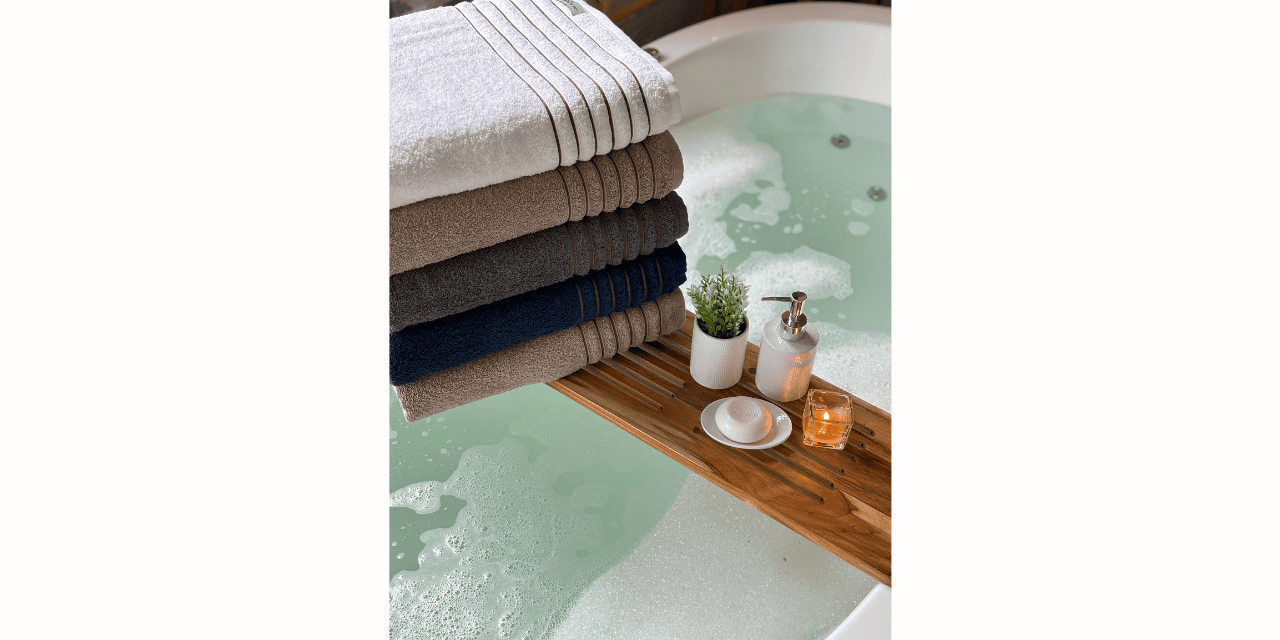
Towels are traditionally evaluated through three key sensations — softness, drying performance and durability after washing. While these qualities are difficult to communicate through photography, technical specifications such as composition, grammage, yarn type, dimensions and finishing provide customers with measurable points of comparison.
Casa da Toalha’s core towel collections, for example, use 100 per cent cotton at 500 g/m². The company highlights how combining grammage with dimensions provides a clearer picture of the actual amount of material in a towel.
A 78 × 145 cm bath towel at 500 g/m² weighs approximately 565 grams, while a 70 × 135 cm towel at the same grammage weighs around 472 grams. Although both products carry the same grammage specification, the difference in dimensions results in a significant difference in total cloth weight.
This demonstrates how technical textile information can help online shoppers compare products beyond broad claims such as “soft” or “premium.”
Consumers Are Learning the Language of Textiles
One of the most notable findings from Casa da Toalha’s digital data is the growing consumer interest in textile terminology.
During the 12 months through July 2026, searches involving grammage, including queries such as “bath towel 500 GSM” and “what is the best GSM for a bath towel,” generated more than 20,000 impressions for a single shop.
The company also recorded approximately 15,000 impressions from searches related to hotel towels, suggesting that hospitality products are influencing consumers’ expectations around towel quality.
According to Casa da Toalha, consumers are increasingly using technical terminology because they need objective ways to compare products that may otherwise make similar claims about softness and quality.
Trousseau Purchases Drive Bath Towel Sales
Casa da Toalha’s first annual data study, published in August 2026, analysed 21,546 orders placed between January and July 2026, alongside 46 months of transaction seasonality and 12 months of search data.
The study found that Brazilian consumers predominantly purchase towels as sets rather than individual replacements.
Approximately 89.70 per cent of bath revenue came from five-piece sets and kits, while individual towels represented 9.70 per cent. The average order value was around R$330.
The findings indicate that consumers often renew multiple bathroom textiles at once instead of replacing individual worn-out towels.
Quality Outranks Price as a Customer Concern
The study also challenges the assumption that price is the primary barrier to purchasing home textiles online.
Among 502 respondents, 22.3 per cent identified product quality as their biggest concern before checkout. Customers wanted reassurance that the towel would be genuinely soft and match their expectations.
By comparison, only 2.2 per cent identified high prices as their main concern. Shipping costs were cited by 16.1 per cent, while 17.3 per cent expressed concerns about being unfamiliar with the retailer.
These findings have influenced Casa da Toalha’s approach to product-page content, with greater emphasis placed on explaining product quality and construction rather than relying primarily on promotional pricing.
Two Cotton Lines, Two Different Purposes
Casa da Toalha offers two collections with the same 500 g/m² specification but different cotton constructions.
The Essence range uses conventional cotton and is positioned for everyday value, while Wave uses combed cotton. In combed cotton, shorter fibres are removed before spinning, resulting in a smoother surface, softer hand feel and reduced lint.
Rather than presenting the lower-priced product as an inferior alternative, the company focuses on clearly communicating the intended use and characteristics of each line.
According to Nielson, transparent product positioning can help reduce returns and customer dissatisfaction, which may ultimately be more valuable than encouraging customers to trade up to a more expensive product.
When Product Data Becomes Invisible
Casa da Toalha’s digital experience has also exposed challenges that go beyond conventional e-commerce merchandising.
The company recently reviewed its customer reviews across 39 product pages and found that review text was not accessible to machines without JavaScript execution. While human visitors could see the reviews, search engines and AI systems operating without executing the relevant scripts could not access the content.
This created a gap between information available to shoppers and information available to increasingly important digital discovery systems.
The company also encountered another issue when creating a plain-text file designed to make its catalogue more accessible to AI assistants. Its first version did not include product ratings, leaving AI systems without important trust signals despite the retailer having collected customer feedback.
The Colour-Data Challenge
Another long-standing data issue involves product colours.
For years, Casa da Toalha registered each colour as a separate product rather than treating colour as a variant within a structured product record. When the company began analysing its historical data, it discovered that colour had not been maintained as a consistent queryable field.
As a result, approximately three quarters of order lines contain no usable colour value. The limitation means the company cannot provide a reliable colour-preference breakdown in its 2026 annual study.
For a textile retailer with 17 years of sales data, the issue highlights a broader challenge: information can exist within a business without being structured in a way that allows it to be effectively analysed or accessed by machines.
Preparing for AI-Led Product Discovery
The evolution of online shopping is increasingly shifting product discovery from traditional lists of links towards direct answers generated by digital assistants.
For home textile retailers, this could make structured and technically accurate product information more important than ever. Details such as fibre composition, grammage, dimensions, construction and verified customer ratings can help digital systems understand and compare products.
For specialist retailers, this shift could also create an opportunity. Technical knowledge that has traditionally been communicated through sales staff, product labels and physical retail environments can become a competitive advantage online — provided that information is clearly written, structured, machine-readable and accurate.
Brusque’s textile heritage dates back to 1892, when the town’s first mill reportedly began with eight hand looms in a merchant’s warehouse. Today, the challenge for textile businesses is no longer simply preserving technical knowledge within mills and manufacturing operations.
The next challenge is ensuring that knowledge survives its journey from production to product page, data feed and ultimately to the digital answer presented to a consumer who may never physically touch the towel before making a purchase.