
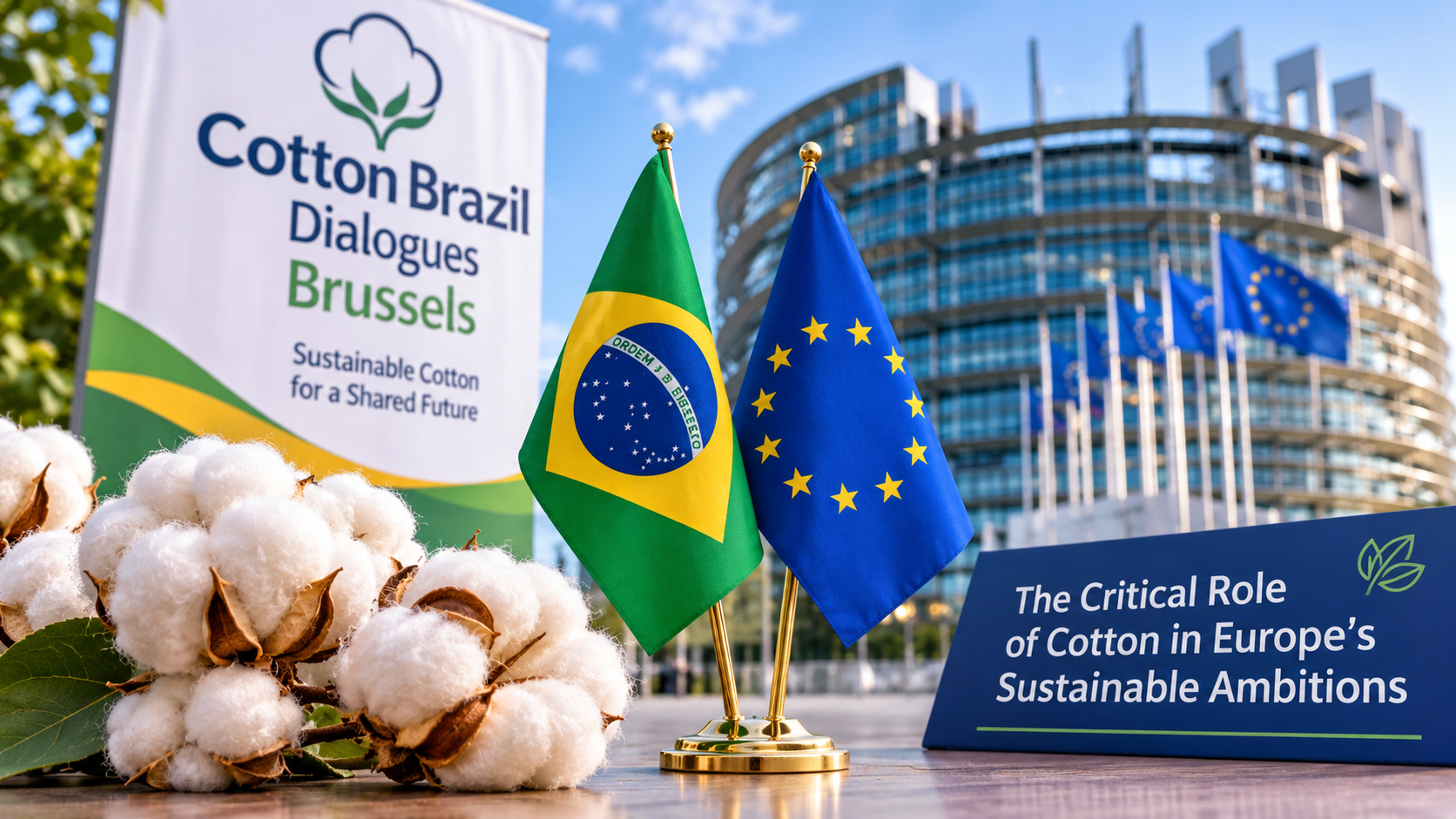
Cotton Brazil will strengthen its engagement with European policymakers and textile industry stakeholders through a series of meetings in Brussels, Belgium, from November 16 to 18, 2026. The initiative aims to highlight cotton’s contribution to sustainable development, climate resilience and responsible sourcing.
The three-day programme will bring together cotton producers, industry representatives, policymakers and diplomatic officials. Discussions will focus on Brazil’s experience in responsible cotton production and opportunities for international cooperation.
One of the main highlights will be the roundtable titled “The Critical Role of Cotton in Europe’s Sustainable Ambitions”, scheduled for November 17 at the European Parliament. The event will be hosted by Member of the European Parliament Hélder Sousa Silva, with support from Cotton Brazil.
Cotton’s Role in Europe’s Sustainability Goals
The roundtable will examine how large-scale cotton production can support sustainability, climate resilience and natural resource protection.
Discussions will take place as the European Union advances policy initiatives, including the Circular Economy Act and EU Bioeconomy Strategy. These frameworks are bringing greater attention to circularity, resource efficiency, sustainable materials and responsible sourcing across the textile value chain.
Cotton Brazil aims to highlight cotton’s contribution beyond textile manufacturing. The natural fibre also supports international development, rural livelihoods and economic resilience.
“At a time when Europe is translating its sustainability ambitions into concrete policies, it is essential that the voices and experiences of producing countries are part of the conversation,” said Lisa Ventura, Head of International Partnerships at the Brazilian Cotton Growers Association (Abrapa).
Responsible Cotton Production and Global Impact
The discussions will position cotton as a global common good, highlighting how large-scale production and responsible agricultural practices can work together.
Cotton supports the livelihoods of approximately 100 million families worldwide. According to the United Nations, its extended value chain sustains around 300–350 million jobs across farming, processing, ginning and logistics.
The programme will also examine cotton’s contribution to rural development, food systems and climate resilience.
Brazil’s experience with tropical agricultural systems will form an important part of the discussions. The delegation will present examples of responsible agricultural practices, innovation and traceability that support measurable sustainability improvements.
Brazil and EU Strengthen Industry Dialogue
Beyond the European Parliament roundtable, the Brazilian delegation will meet H.E. Pedro Miguel da Costa e Silva, Brazilian Ambassador to the European Union, on November 17.
The meeting will address challenges and opportunities for Brazilian commodities under evolving EU policies.
On November 18, the delegation will meet agricultural attachés and participate in a working lunch with representatives of other natural fibre-producing countries. Discussions will cover European market regulations, commercial challenges and opportunities for cooperation among producing nations.
The agenda will also address transparency, circularity, traceability and responsible sourcing. Participants will discuss the importance of science-based sustainability frameworks that recognise different global production systems.
Lisa Ventura also highlighted the importance of the EU-Mercosur Agreement in strengthening trade and sustainability cooperation between Brazil and Europe.
Through Cotton Brazil Dialogues Brussels, the initiative aims to expand international partnerships and promote responsible cotton production. It also seeks to strengthen cooperation on sustainability, traceability and the future of natural fibres.